

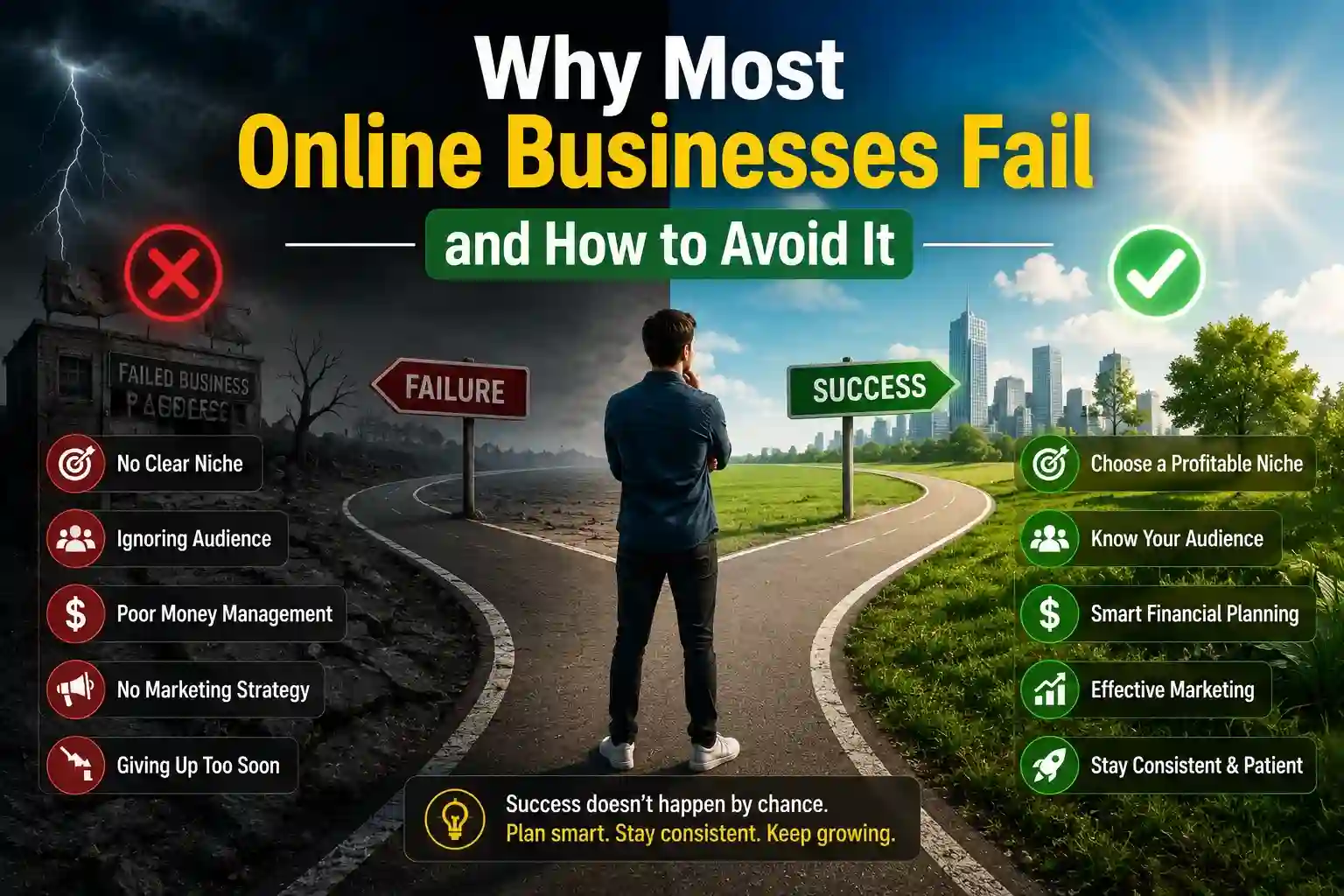
The promise of building an online business draws millions of people every year. A fraction of them build something sustainable. The rest spend months — sometimes years — working hard on businesses that quietly stop before they ever gain real traction.
The failure rate isn’t explained by bad luck or saturated markets. It’s explained by specific, identifiable patterns that repeat across nearly every business that doesn’t make it. Understanding those patterns before they appear is what separates founders who build something real from those who eventually return to employment wondering what went wrong.
The Root Causes Most Failed Online Businesses Share
Online business failure rarely arrives suddenly. It accumulates through a series of decisions that each seem reasonable in isolation but collectively create a structure that can’t sustain itself.
- No genuine product-market fit — The most common reason businesses fail is that the founder built something they wanted to exist rather than something a specific audience actively needs and will pay for. Enthusiasm for an idea is not evidence of market demand
- Unclear target audience — Trying to appeal to everyone produces messaging, products, and marketing strategies that resonate with no one. Businesses without a defined customer profile can’t make coherent decisions about anything
- No differentiation from existing options — Entering a market with a product or service identical to what competitors already offer, at similar pricing, with no compelling reason to choose differently, results in invisibility rather than competition
- Inconsistent execution — Many online businesses fail not because the strategy was wrong but because it was abandoned before compounding had time to work. Publishing content for six weeks, running ads for a month, and switching models when results don’t appear immediately destroys the continuity that growth requires
- Revenue dependency on a single channel — Businesses built entirely on one traffic source — a single social platform, one ad network, or a single referral partner — collapse when that channel changes, restricts access, or becomes cost-prohibitive
- Treating the business like a hobby — Without revenue targets, performance tracking, and operational discipline, online businesses drift rather than grow. Ambiguity about goals produces ambiguous results
Recognizing these patterns in an existing business is as valuable as avoiding them in a new one. Most of them are correctable — but only once they’re honestly acknowledged.
Execution Failures That Kill Businesses With Good Ideas
A sound business concept doesn’t guarantee survival. The execution layer — how the business actually operates day to day — determines whether a good idea generates revenue or stays permanently in potential.
- Weak offers — An offer that doesn’t clearly communicate what the customer receives, why it matters to them specifically, and what outcome they can expect will not convert regardless of how much traffic reaches it
- No follow-up system — Most buyers don’t purchase on first exposure. Businesses without email sequences, retargeting campaigns, or structured follow-up processes lose the majority of potential revenue to a gap that costs almost nothing to close
- Poor unit economics — Selling products or services at prices that don’t cover customer acquisition costs and operational expenses creates a business that shrinks as it scales. Understanding the true cost of acquiring each customer is non-negotiable
- Absence of a content or SEO strategy — Businesses that never build organic visibility remain permanently dependent on paid traffic or social algorithms — both of which are expensive, unreliable, or both
- Slow response to customer feedback — Markets signal what they want through purchasing behavior, questions, complaints, and reviews. Businesses that ignore these signals and continue offering unchanged products lose relevance faster than competitors who adapt
- No financial tracking or cash flow awareness — Operating without clear visibility into revenue, expenses, and margin creates situations where a business appears to be working until it suddenly can’t meet its obligations
Each of these failures has a direct, practical solution. None of them require significant capital to address — only attention and willingness to make changes before the damage becomes permanent.
What Businesses That Survive Do Differently
Sustainable online businesses share characteristics that failed ones typically lack — and most of those characteristics are behavioral rather than financial.
Successful founders validate demand before building. They confirm that people will pay for a solution before investing in creating it. This single discipline eliminates the most expensive category of online business failure before it can occur.
They also commit to a single business model long enough to learn it properly. Switching from dropshipping to affiliate marketing to coaching to SaaS within a single year produces no depth of skill in any of them — and depth is what creates competitive advantage.
Customer feedback is treated as a product development resource rather than a nuisance. The businesses that improve fastest are those that systematically collect, analyze, and respond to what customers say — not just what they purchase.
Financial discipline separates businesses that scale from those that plateau. Knowing the margin on every product, the cost of every customer acquisition channel, and the monthly runway available allows founders to make strategic decisions rather than reactive ones.
Finally, the businesses that survive long enough to succeed treat setbacks as data rather than verdicts. Every underperforming campaign, every product that didn’t sell, and every customer who churned contains information that improves the next decision — if the founder looks for the lesson rather than abandoning the model.
Failure Is Predictable — Which Means It’s Preventable
The patterns behind online business failure are consistent enough that they function almost like a checklist. Businesses that avoid unclear positioning, single-channel dependency, weak offers, and inconsistent execution dramatically improve their survival odds — not because success becomes guaranteed, but because the most common failure modes are removed from the equation.
Build with awareness of what typically goes wrong. Execute with the discipline to stay consistent long enough for compounding to work. Adjust based on what the market actually shows you rather than what you hoped it would show you.
That combination doesn’t eliminate risk. But it eliminates the preventable failures that end most online businesses before they ever find out what they could have become.
Frequently Asked Questions
Q: What is the most common reason online businesses fail in the first year?
Lack of validated product-market fit combined with insufficient customer acquisition strategy. Most first-year failures involve founders who built something without confirming demand and then had no reliable system for reaching buyers once the product existed.
Q: How long should I give an online business before concluding it isn’t working?
At least twelve months of consistent, strategic execution before drawing conclusions about viability. Most online business models require six to nine months before meaningful data exists — and many founders quit inside that window, just before results would have appeared.
Q: Can an online business recover after a failed launch?
Yes — frequently. A failed launch reveals specific information about offer positioning, audience targeting, or messaging that a revised approach can address directly. Many successful online businesses launched poorly before finding the adjustment that made them work.
Q: Is competition the main reason online businesses fail?
Rarely. Most online businesses fail due to internal execution problems — unclear positioning, poor offers, inconsistent marketing — rather than competitive pressure. Markets with strong competition usually indicate strong demand, which is a positive signal for well-differentiated entrants.
Q: How do I know if my online business idea has real potential before investing significantly?
Presell the offer before building the product. Describe the solution clearly to a specific audience and ask them to commit financially — through a deposit, pre-order, or paid waitlist. Genuine financial commitment from strangers is the only reliable proof of market demand.