
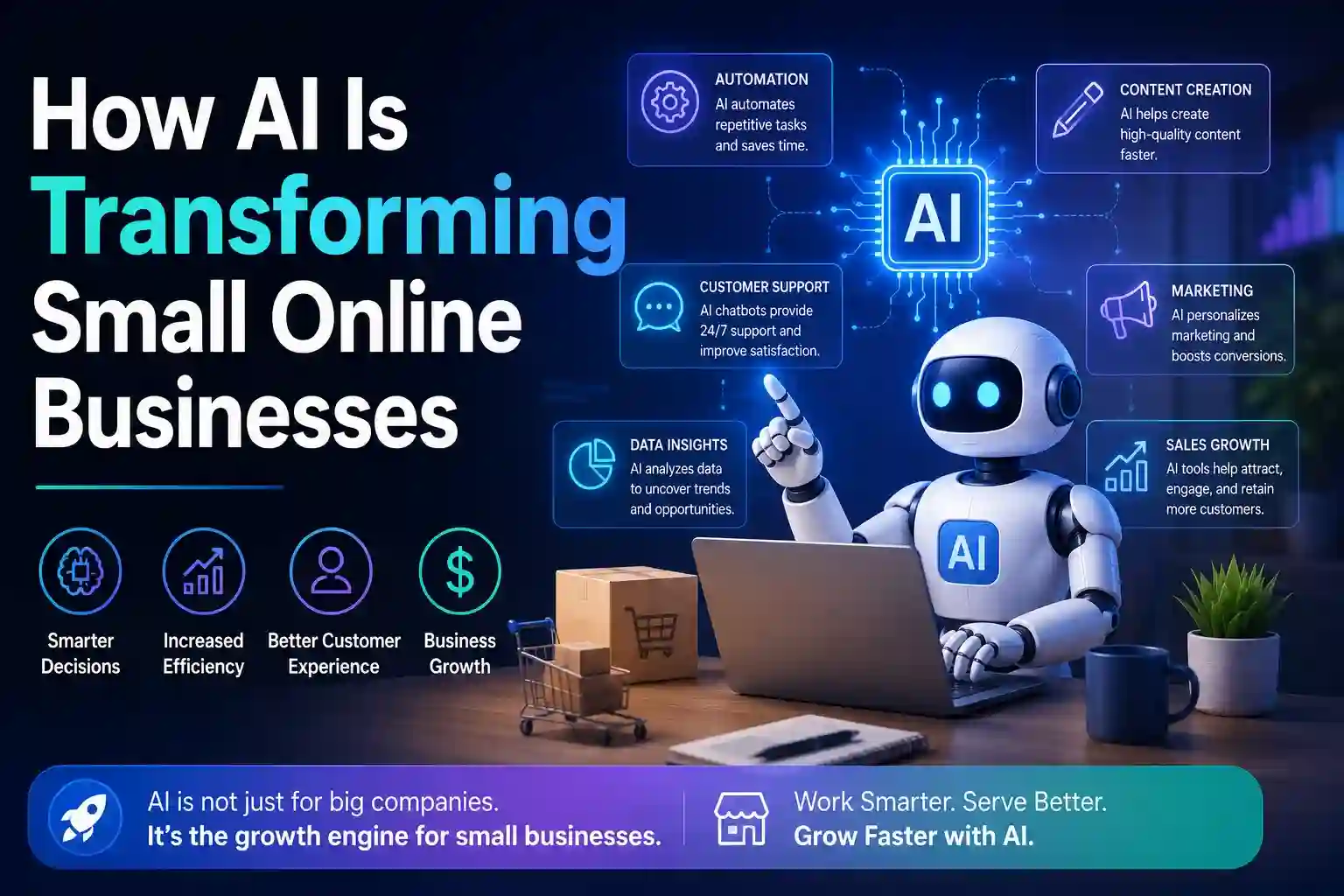
Small online businesses are experiencing a capability shift that has no historical parallel. Tasks that previously required agencies, large teams, or significant budgets are now handled by AI tools that cost less per month than a single freelance hour.
The transformation isn’t theoretical. It’s showing up in conversion rates, customer retention, content output, and operational efficiency for businesses run by one or two people who made the decision to adopt these tools early.
Understanding where AI delivers the most impact helps online business owners prioritize adoption strategically rather than chasing every new tool that enters the market.
AI Is Reshaping How Small Online Businesses Attract Customers
Customer acquisition has historically been the area where small online businesses felt most outmatched by larger competitors. Bigger ad budgets, dedicated marketing teams, and sophisticated targeting capabilities created a gap that was difficult to close with limited resources.
AI has restructured that dynamic significantly.
- Predictive audience targeting — AI ad platforms analyze behavioral signals across vast datasets to identify high-conversion audience segments automatically, making smaller budgets perform with the efficiency previously reserved for enterprise campaigns
- AI-generated content at scale — Product descriptions, blog posts, social captions, and email sequences can now be produced consistently without outsourcing, allowing small teams to maintain publishing volume that builds search authority over time
- Personalized email marketing — AI segments subscriber lists dynamically based on purchase history, browsing behavior, and engagement patterns — sending the right message to the right person at the statistically optimal time
- Conversion rate optimization — AI tools analyze heatmaps, session recordings, and A/B test results to recommend specific website changes that improve the percentage of visitors who become buyers
- Automated SEO recommendations — Keyword gap analysis, internal linking suggestions, and on-page optimization guidance that previously required SEO consultants are now surfaced automatically through affordable AI-powered platforms
- Social media performance analysis — AI identifies which content formats, posting times, and topic categories generate the most engagement for a specific account — removing the guesswork from organic growth strategy
Each of these capabilities compounds. Better targeting reduces wasted ad spend. Better content builds organic traffic. Better email personalization improves repeat purchase rates. Combined, they create a customer acquisition engine that improves continuously.
AI Tools Transforming Daily Operations for Online Business Owners
Beyond marketing, the internal operations of running a small online business consume enormous amounts of owner time. AI is systematically eliminating the manual work from processes that previously had no alternative to human attention.
- Intelligent customer support — AI chatbots handle order inquiries, return requests, product questions, and complaint resolution around the clock, reducing support volume that reaches the owner by a substantial margin
- Dynamic pricing optimization — AI monitors competitor pricing, demand signals, and inventory levels to recommend or automatically adjust product prices for maximum revenue without manual monitoring
- Fraud detection and order screening — Machine learning models identify suspicious transaction patterns and flag high-risk orders before fulfillment, reducing chargebacks and inventory loss
- Automated inventory forecasting — AI predicts restocking needs based on sales velocity, seasonal trends, and supplier lead times — preventing both stockouts and excess inventory situations
- Financial reporting and cash flow analysis — AI bookkeeping tools categorize transactions, identify spending anomalies, and generate plain-language summaries of financial health without manual data entry
- Review and reputation monitoring — AI tools scan mentions across platforms, summarize sentiment trends, and draft response suggestions — keeping the business’s online reputation managed without daily manual checks
Individually, each of these saves hours weekly. Collectively, they free the business owner to focus on product development, supplier relationships, and strategic growth decisions rather than operational maintenance.
AI Is Changing What Small Online Businesses Can Build Alone
Perhaps the most profound shift AI has created isn’t in any single tool category — it’s in what a solo or two-person online business can now realistically build and sustain.
Product development has accelerated. AI assists with market research, competitor analysis, and identifying unmet customer needs that would previously require a dedicated research function.
Customer experience has improved. Personalization that large retailers deploy through sophisticated technology stacks is now accessible through affordable AI integrations that small stores implement in hours.
Brand communication has become more consistent. AI writing tools help small business owners maintain a professional, on-brand voice across every customer touchpoint — from product pages to post-purchase emails — without the inconsistency that comes from managing multiple contractors.
The ceiling on what a small online business can deliver to its customers has risen considerably. AI didn’t just make existing tasks faster — it made previously impossible tasks accessible.
The Advantage Goes to Those Who Adopt Deliberately
AI tools don’t create results by existing in a tech stack. They create results when they’re implemented around clear business objectives, integrated into actual workflows, and evaluated regularly against measurable outcomes.
Small online business owners who approach AI adoption with that discipline — choosing tools that address real bottlenecks rather than following trend cycles — are the ones seeing the meaningful competitive separation that early adoption makes possible.
Frequently Asked Questions
Q: Which AI tools are most useful for a small online store just starting with AI?
Email personalization, AI chatbots for customer support, and AI-assisted product description writing deliver the fastest visible impact for small online stores. These three address high-volume, time-consuming tasks with immediate measurable results.
Q: Does using AI for content creation hurt SEO rankings?
AI-assisted content that is edited for accuracy, originality, and genuine helpfulness performs well in search. Content published without human review or value addition — thin, repetitive, or factually unreliable — risks poor performance regardless of how it was created.
Q: Can AI replace a customer service team for a small online business?
AI handles the majority of routine inquiries effectively — order status, return policies, product specifications. Complex disputes, sensitive complaints, and relationship-building conversations still benefit from human judgment and empathy.
Q: How much do AI tools for small online businesses typically cost?
Most AI tools relevant to small online businesses are priced between $20 and $150 per month. Many offer free tiers with enough functionality to test impact before committing to paid plans.
Q: Is AI adoption risky for small online businesses with limited technical knowledge?
Most modern AI business tools are designed for non-technical users with guided setup and plain-language interfaces. The adoption risk is low — the greater risk for most small businesses is delaying adoption while competitors move ahead.