

Quick Answer: How Much Benadryl Can You Give a Dog?
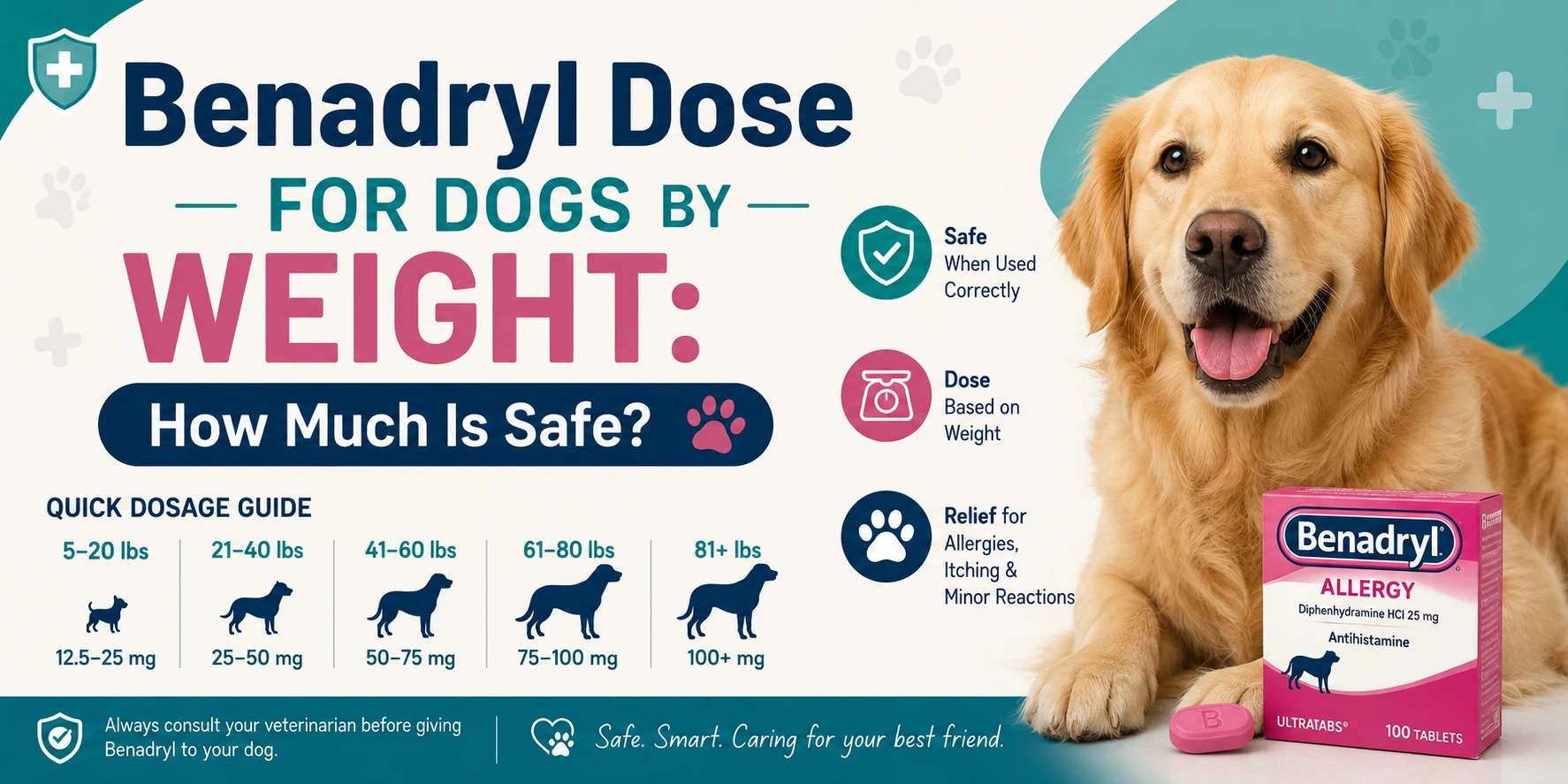
The general rule most vets quote is 1 mg of Benadryl per pound of your dog’s body weight, given two to three times a day. So a 20-pound dog would get roughly 20 mg per dose, and a 50-pound dog would get around 50 mg.
That’s the short version. But if you’re standing in your kitchen right now with a bottle of Benadryl in one hand and an itchy, miserable dog at your feet, you probably want more than a one-line answer — you want to know it’s actually safe, how to measure it correctly, and what could go wrong. So let’s slow down and go through it properly.
I’ll say this upfront: this article isn’t a replacement for calling your vet. It’s meant to give you the same information a vet would likely tell you over the phone in a non-emergency situation, so you’re not guessing in the dark at 9 p.m. on a Sunday.
Is Benadryl Safe for Dogs?
Yes, generally — plain diphenhydramine (the active ingredient in Benadryl) is one of the few human medications vets do sometimes recommend for dogs. It’s been used in veterinary medicine for decades to manage mild allergic reactions, itching, motion sickness, and anxiety around things like car rides or thunderstorms.
But “generally safe” isn’t the same as “safe for every dog in every situation.” A few things matter a lot here:
- The formulation matters. Plain Benadryl (diphenhydramine only) is fine. Benadryl-D, Benadryl Allergy Plus Congestion, or anything with acetaminophen, pseudoephedrine, or alcohol added is not okay for dogs. Some of those ingredients are genuinely dangerous.
- The dog’s health history matters. Dogs with glaucoma, heart disease, high blood pressure, seizure disorders, or urinary retention issues need a vet’s input before taking it.
- What else the dog is on matters. Benadryl can interact with sedatives, certain antidepressants, and other allergy medications.
I’ve talked to breeders who keep Benadryl in their car’s glove box for bee stings during hikes, and that’s a reasonable use case. But I’ve also heard from a dog owner whose senior Lab had an undiagnosed heart murmur, and the vet specifically told her to avoid antihistamines without a check-up first. Context matters more than the dose itself.
Benadryl Dosage for Dogs by Weight (Chart)
Here’s a simple weight-based breakdown using the standard 1 mg per pound guideline, dosed up to three times a day (every 8–12 hours). Benadryl typically comes in 25 mg tablets, so I’ve included how that translates in real life.
| Dog’s Weight | Benadryl Dose (mg) | In 25 mg Tablets |
|---|---|---|
| 5 lbs | 5 mg | 1/4 tablet |
| 10 lbs | 10 mg | 1/2 tablet |
| 20 lbs | 20 mg | 3/4 tablet |
| 25 lbs | 25 mg | 1 tablet |
| 30 lbs | 30 mg | 1 tablet |
| 40 lbs | 40 mg | 1.5 tablets |
| 50 lbs | 50 mg | 2 tablets |
| 60 lbs | 60 mg | 2.5 tablets |
| 70 lbs | 70 mg | 2.5–3 tablets |
| 80 lbs | 80 mg | 3 tablets |
| 90 lbs | 90 mg | 3.5 tablets |
| 100 lbs | 100 mg | 4 tablets |
A couple of practical notes on this chart. First, tablet splitting isn’t precise — a pill cutter helps, but don’t stress over being off by a couple of milligrams. Second, most vets suggest starting at the lower end of the range, especially the first time you give it, just to see how your individual dog reacts. Some dogs get noticeably drowsy on 1 mg/lb; others barely blink.
How Much Benadryl for a Dog With Itching or Allergies?
This is probably why you’re here. Seasonal allergies, bug bites, mild hives, or reactions to something they rolled in outside — Benadryl can take the edge off, but it’s not a cure-all.
For itching specifically, the same 1 mg per pound dosing applies, usually two to three times daily. Here’s the honest part most articles skip: Benadryl works reasonably well for mild, localized itching (a bug bite, a small hive outbreak) but it’s often underwhelming for dogs with chronic skin allergies or atopic dermatitis. If your dog is scratching constantly week after week, Benadryl is a band-aid, not a fix. That situation usually needs an actual vet diagnosis — could be food allergies, environmental allergies, or a skin infection that antihistamines won’t touch.
I’ve seen this play out with a friend’s Frenchie who seemed to respond to Benadryl for about two weeks before the itching came right back. Turned out to be a yeast infection in his skin folds, not allergies at all. Benadryl was masking a symptom, not solving the actual problem.
How Often Can I Give My Dog Benadryl?
Most vets say every 8 hours, so up to three doses in a 24-hour period, is the standard ceiling. Giving it more frequently than that increases the risk of side effects without necessarily improving the allergy relief.
If you find yourself needing to dose your dog three times a day for more than a few days in a row, that’s usually a sign it’s time for a vet visit rather than continuing to manage it at home indefinitely.
Side Effects to Watch For
Drowsiness is the most common one — it’s actually the reason vets sometimes use Benadryl before car trips or vet visits, not just for allergies. Beyond that, keep an eye out for:
- Dry mouth
- Urinary retention
- Loss of appetite
- Hyperactivity (yes, some dogs get the opposite of sleepy — it happens more in puppies)
- Rapid breathing or a fast heart rate
Most of these are mild and pass on their own. But if your dog seems disoriented, has trouble walking, or their breathing seems labored rather than just quick, that’s a call-your-vet-now situation, not a wait-and-see one.
When Benadryl Isn’t the Right Choice
Benadryl is not the go-to for a severe allergic reaction — facial swelling, hives spreading rapidly, or difficulty breathing. Those situations need emergency veterinary care immediately. Antihistamines can help with mild symptoms, but they work too slowly and too mildly to manage anaphylaxis.
It’s also not a long-term anxiety solution, even though it’s commonly used for short bursts like fireworks or vet visits. If your dog has ongoing anxiety, there are better-suited medications a vet can prescribe.
A Few Practical Tips Before You Dose Your Dog
- Check the label twice. Plain diphenhydramine only — no “D,” no “Plus,” no xylitol-sweetened liquid formulas.
- Weigh your dog first, don’t estimate. A guess of “about 30 pounds” can be off by enough to matter.
- Give it with a small amount of food to reduce stomach upset.
- Keep a log the first time you use it — note the time, dose, and how your dog reacted, in case you need to report it to a vet later.
- If your dog is a puppy, pregnant, nursing, senior, or has any chronic condition, call your vet before giving the first dose, not after.
The Bottom Line
Benadryl can be a genuinely useful tool to have on hand for mild allergic reactions and occasional itching, and the 1 mg per pound guideline is a reasonable starting point for most healthy adult dogs. But it works best as a short-term, situational aid — not a standing solution for ongoing skin problems. If you’re using it more than occasionally, or it doesn’t seem to be helping, that’s your dog telling you it’s time for an actual diagnosis rather than another dose.
FAQs
1. Is Benadryl safe for dogs?
Plain diphenhydramine is generally safe for healthy adult dogs at the standard dose, but dogs with certain health conditions or on other medications should be cleared by a vet first.
2. How much Benadryl can I give my dog?
The common guideline is 1 mg per pound of body weight, up to three times a day, though your vet may adjust this based on your dog’s health.
3. How much Benadryl for a dog that weighs 20 pounds?
Around 20 mg per dose, which is close to 3/4 of a standard 25 mg tablet.
4. Can I give my dog Benadryl for itching?
Yes, it can help with mild, occasional itching, but it’s often less effective for chronic or recurring skin allergies.
5. Can I give my dog Benadryl for allergies?
Yes, for mild seasonal or contact allergies. For severe reactions like facial swelling or trouble breathing, seek emergency vet care instead.
6. How often can I give my dog Benadryl for itching?
Typically every 8 to 12 hours, not more than three times in 24 hours.
7. Is Benadryl good for dogs long-term?
It’s better suited for short-term or occasional use. Long-term itching usually needs a proper diagnosis rather than ongoing antihistamine use.
8. What kind of Benadryl is safe for dogs?
Only plain diphenhydramine tablets or liquid. Avoid any formula labeled “D,” “Plus,” or “Congestion,” and avoid liquid formulas containing xylitol.
9. Can Benadryl make my dog sleepy?
Yes, drowsiness is the most common side effect, which is why it’s sometimes used before car rides or stressful events.
10. What are signs my dog is having a bad reaction to Benadryl?
Disorientation, difficulty walking, rapid or labored breathing, or an unusually fast heart rate warrant an immediate call to your vet.
11. Can puppies take Benadryl?
Sometimes, but dosing for puppies should always be confirmed with a vet first due to their smaller size and developing systems.
12. Does Benadryl help with dog anxiety?
It can take the edge off mild, situational anxiety, but it’s not a reliable long-term anxiety treatment.
13. Can I give my dog Benadryl every day?
Occasional daily use for a few days is generally fine, but ongoing daily use should be discussed with your vet.
14. How long does it take Benadryl to work in dogs?
Usually 30 minutes to an hour, with effects lasting around 8 hours.
15. What should I do if my dog ate too much Benadryl?
Contact your vet or an animal poison control hotline right away, even if your dog seems fine — some symptoms of overdose take time to appear.