

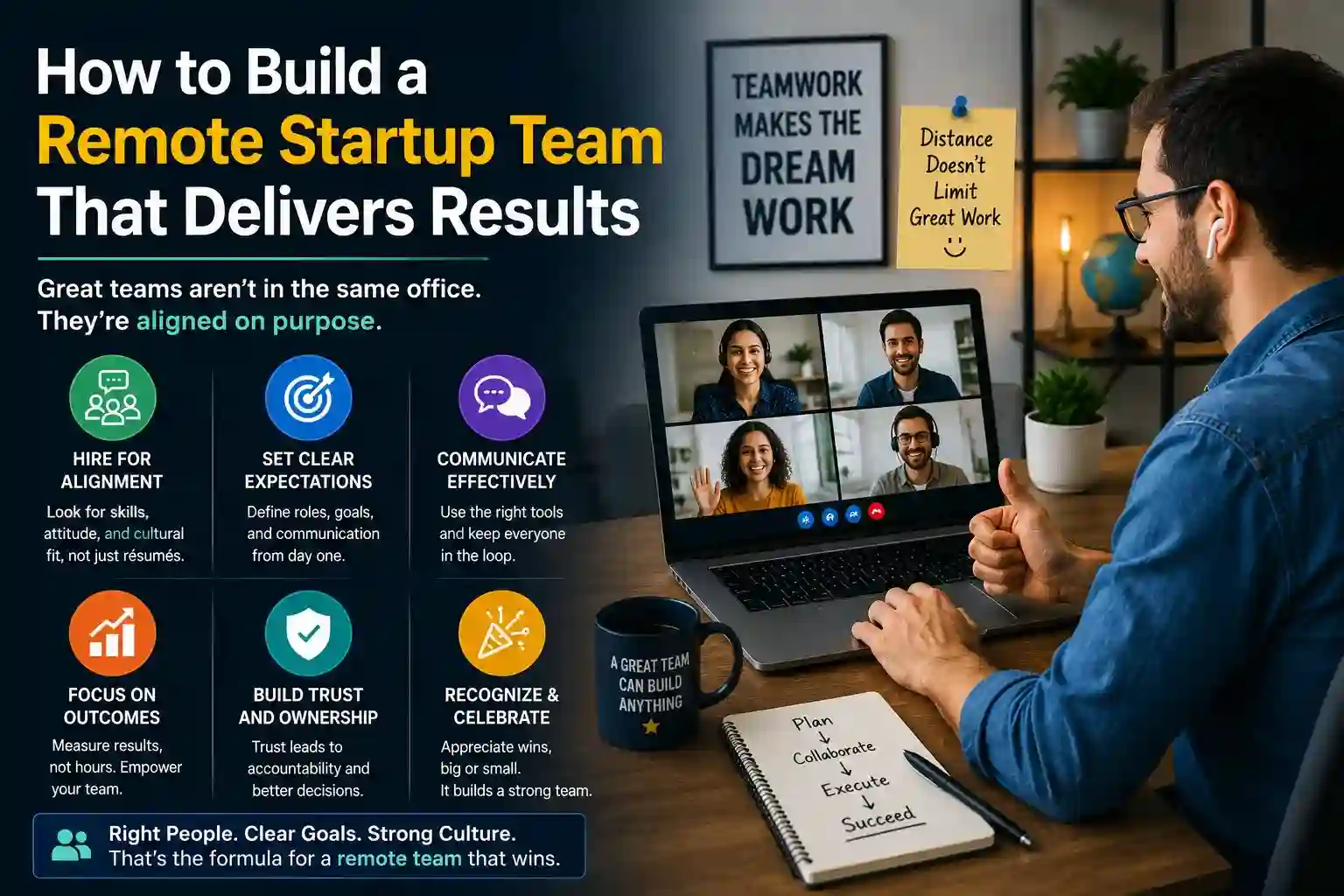
A remote team that consistently delivers isn’t built by accident. It’s built through deliberate hiring, clear systems, and a culture that functions without physical proximity.
Founders who treat remote work as an afterthought — assembling people quickly and hoping communication sorts itself out — discover the problems early and painfully. Those who treat remote operations as a core competency build teams that outperform office-bound competitors in both productivity and retention.
The difference is almost entirely in how the team is set up from the start.
Hire for Remote Compatibility, Not Just Skill
Technical ability matters. But in a remote environment, the way someone works independently matters just as much as what they can produce.
Remote-compatible team members share a distinct set of working characteristics that determine whether they thrive without in-person oversight or quietly underperform across time zones.
- Self-direction — The ability to prioritize tasks, set personal deadlines, and make progress without waiting for instruction separates remote performers from those who need office structure to function
- Written communication clarity — Remote teams run on text. Someone who communicates ambiguously in writing creates compounding confusion across every channel they touch
- Proactive status updates — High performers in remote settings share progress without being asked. They flag blockers early rather than going silent when stuck
- Comfort with asynchronous work — Not every question needs an immediate answer. Team members who respect async rhythms protect deep work time for everyone
- Accountability without surveillance — Remote hiring works when candidates have a demonstrated history of meeting commitments independently, not just when monitored
- Cultural adaptability — Distributed teams often span multiple countries. Openness to different working styles, time zones, and communication norms prevents friction that kills collaboration
Assessing these traits requires more than a standard interview. Trial projects, paid test tasks, and reference checks focused specifically on remote performance reveal far more than a résumé ever will.
Build Communication Systems Before You Need Them
The most common failure point in remote startups isn’t talent — it’s infrastructure. When communication systems are improvised rather than designed, important decisions get lost in chat threads, context disappears between meetings, and team members default to working in silos.
Effective remote teams establish clear protocols before the team grows large enough to make dysfunction expensive.
- Define which channel handles which type of communication — Real-time messaging for urgent items, project tools for task updates, email for formal external communication, and video for complex discussions requiring nuance
- Document decisions immediately — Every significant decision made in a call or chat should be recorded in a shared, searchable location within 24 hours
- Establish meeting rhythms early — Weekly team syncs, one-on-one check-ins, and async standups create predictable touchpoints without filling calendars with unnecessary calls
- Create onboarding documentation before the first hire — New team members who receive clear written guides on tools, processes, and expectations contribute faster and ask fewer repeated questions
- Set response time expectations explicitly — Ambiguity about when messages should be answered creates anxiety and misaligned expectations. Defined norms remove both
- Use shared visibility tools — Project dashboards where anyone can see what others are working on reduce status meetings and build natural accountability across the team
Systems that feel over-engineered for a three-person team become essential infrastructure at ten. Building them early costs little and prevents the chaotic retrofit that derails growing remote startups.
Create a Performance Culture That Doesn’t Rely on Presence
Office environments often measure effort through visibility — who arrives early, who stays late, who appears busy. Remote teams have no such proxy, which forces a healthier question: what actually got done?
Outcome-based performance management is both more equitable and more effective in distributed settings. It begins with defining success clearly for every role — not just job descriptions, but specific, measurable outputs tied to business goals.
Regular one-on-one conversations focused on progress, obstacles, and professional development replace the informal feedback that happens naturally in offices. Without these structured touchpoints, remote team members often feel disconnected from leadership and uncertain about their standing.
Recognition matters more in remote settings than founders typically expect. Celebrating wins publicly — in team channels, in meetings, in written updates — builds morale that physical distance otherwise erodes.
Career growth pathways need to be explicit. Remote employees who can’t see a future in the organization disengage quietly before eventually leaving. Transparent conversations about progression, compensation, and responsibility growth retain the performers who remote-first companies most need to keep.
Remote Teams Work When Remote Is Treated as a Strategy, Not a Compromise
The founders who build the strongest remote teams don’t view distributed work as a limitation imposed by geography or budget. They view it as a genuine advantage — access to global talent, reduced overhead, and a culture built on output rather than optics.
That mindset shapes every hiring decision, every system built, and every conversation with the team. When remote is designed intentionally, the results speak for themselves.
Frequently Asked Questions
Q: How do you maintain team culture in a fully remote startup?
Culture in remote teams is built through consistent rituals — regular video check-ins, shared wins celebrated publicly, and clear values demonstrated in leadership behavior. Informal virtual gatherings also help replicate the casual connection that offices provide naturally.
Q: What tools does a remote startup team actually need to function effectively?
The essentials are a team messaging platform, a project management tool, a video conferencing solution, and a shared documentation system. Most successful remote startups operate on fewer than five core tools to avoid fragmentation.
Q: How do you manage performance without micromanaging remote employees?
Define clear deliverables, set agreed timelines, and conduct regular one-on-one check-ins focused on outcomes rather than activity. Trust builds through demonstrated results, not monitoring software.
Q: Should a startup hire remote contractors or full-time remote employees first?
Contractors offer flexibility and lower risk during the validation phase. Full-time remote hires make sense once the role is stable, the workload is consistent, and the business can support long-term commitment.
Q: How do you handle time zone differences in a distributed startup team?
Establish a core overlap window — typically two to four hours — where all team members are expected to be available simultaneously. Outside that window, async communication handles the majority of collaboration effectively.