

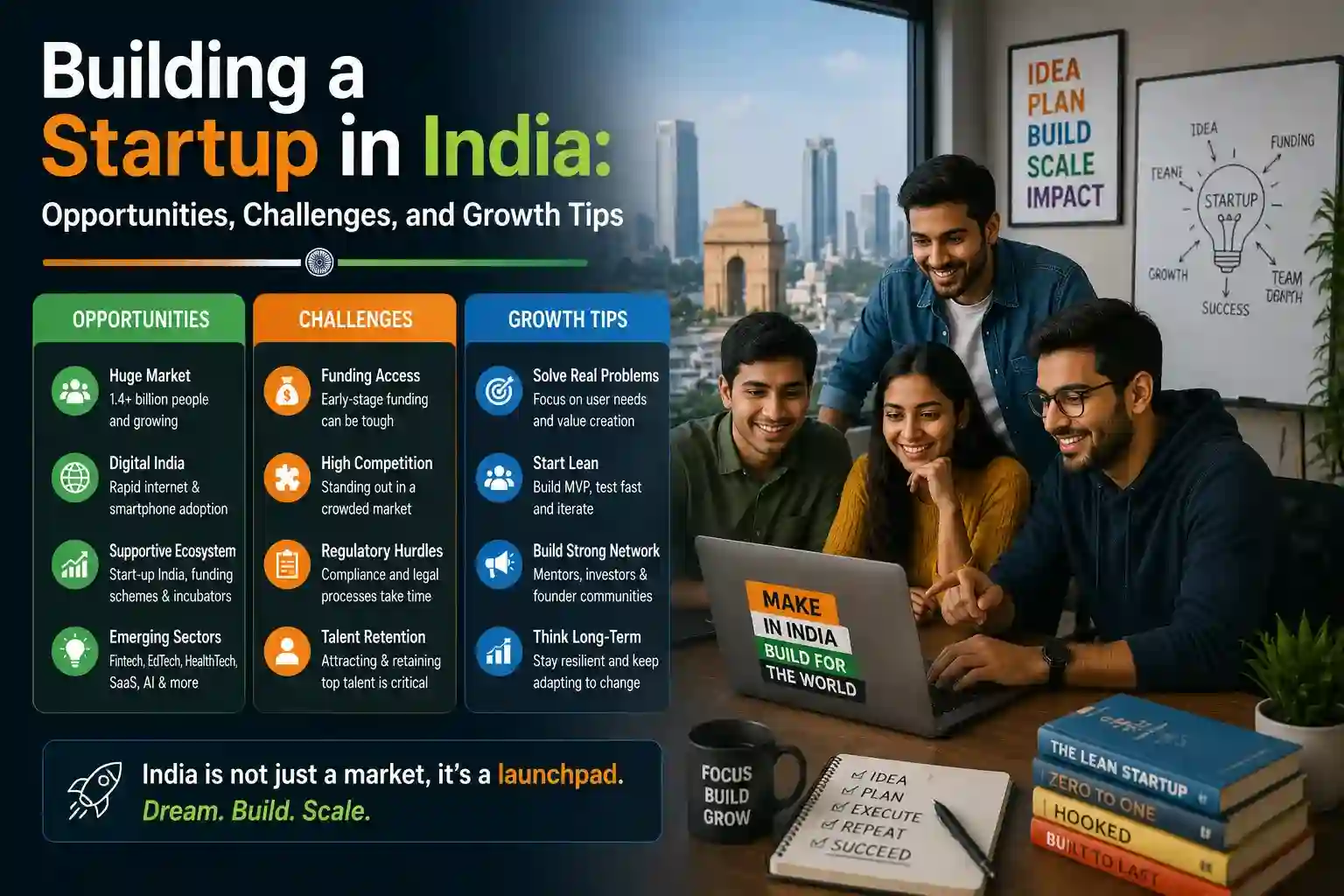
India has quietly become one of the most dynamic startup environments on the planet. With one of the world’s largest youth populations, rapidly expanding internet penetration, and a government actively incentivizing entrepreneurship, the conditions for building a business here have never been more favorable.
But favorable conditions don’t guarantee easy execution. Founders who understand both the opportunities and the friction points enter with realistic expectations — and those are the ones who build something that lasts.
Why India Offers Exceptional Startup Opportunities Right Now
The structural advantages available to Indian founders extend well beyond low operating costs. Several converging factors are creating genuine market openings that didn’t exist a decade ago.
- Massive underserved markets — Hundreds of millions of Indians in Tier 2 and Tier 3 cities are gaining smartphone access and disposable income simultaneously, creating demand for localized products and services that metro-focused companies consistently underserve
- Young, tech-literate population — A median age under 30 combined with widespread mobile adoption means digital products reach scale faster in India than in most comparable economies
- Government support programs — The Startup India initiative offers tax exemptions, simplified compliance, and access to funding networks for registered startups, reducing early-stage financial burden meaningfully
- Deep engineering talent pool — India produces a substantial volume of technical graduates annually, giving product-focused startups access to skilled development resources at globally competitive rates
- Growing domestic consumption — Rising middle-class spending across categories including health, education, fintech, and logistics is generating sustained demand that purely export-oriented business models are no longer required to capture
- Established investor ecosystem — Angel networks, venture capital firms, and accelerators with India-specific mandates have multiplied significantly, improving access to early-stage funding outside major metros
The opportunity density is real. The challenge is choosing which opening to pursue and building a model that survives contact with Indian market realities.
Challenges Every Indian Startup Founder Must Navigate
Acknowledging challenges isn’t pessimism — it’s preparation. The founders who scale successfully in India are rarely surprised by these obstacles because they planned for them from the beginning.
- Regulatory complexity — Business registration, GST compliance, labor laws, and sector-specific licensing vary by state and change with relative frequency. Engaging a knowledgeable compliance professional early prevents costly errors that stall operations
- Infrastructure inconsistency — Logistics, power reliability, and internet connectivity vary dramatically between urban and rural markets. Business models that depend on consistent infrastructure need contingency planning baked in
- Price sensitivity at scale — Indian consumers across most segments are exceptionally value-conscious. Unit economics that work at premium pricing often break when the addressable market requires affordable tiers
- Talent retention in competitive markets — Bengaluru, Hyderabad, and Pune face significant talent competition between startups and established technology employers. Retention requires more than compensation — career growth visibility and culture matter substantially
- Access to capital outside major hubs — Founders based outside Mumbai, Delhi, and Bengaluru face a steeper path to investor visibility. Remote fundraising requires stronger documentation, networks, and demonstrated traction before meetings become accessible
- Customer acquisition cost pressures — Performance marketing costs have risen sharply as competition for digital attention increases. Organic growth strategies and referral mechanics are no longer optional for capital-efficient scaling
Each of these is solvable. None of them disappear by being ignored.
Practical Growth Tips Specific to the Indian Market
Generic startup advice doesn’t always translate cleanly to the Indian context. These strategies account for the specific dynamics that determine success here.
Building in vernacular languages from early stages — rather than treating regional language support as a later feature — unlocks Tier 2 and Tier 3 markets that English-first products structurally cannot reach.
Distribution partnerships with established local players accelerate market entry in ways that direct-to-consumer digital marketing alone cannot replicate, particularly in categories where trust and familiarity drive purchase decisions.
Frugal innovation — designing products that deliver genuine value at accessible price points rather than stripping down premium products — consistently outperforms top-down pricing strategies in Indian markets.
Community-led growth through WhatsApp groups, regional influencer networks, and word-of-mouth referral systems remains disproportionately effective compared to equivalent investment in paid channels.
Registering under the Startup India program, even before revenue begins, unlocks tax benefits and government tender eligibility that reduce early operational costs meaningfully.
India Rewards Founders Who Build for India
The startups that struggle in India are often those applying frameworks built for Western markets onto a context with fundamentally different consumer behavior, infrastructure realities, and competitive dynamics.
The ones that succeed treat India not as a discount version of another market but as a distinct opportunity with its own logic. Build for the actual customer, at a price they can sustain, through channels they already trust — and the scale available here becomes one of the most compelling business advantages on earth.
Frequently Asked Questions
Q: What is the easiest way to register a startup in India?
Registering as a Private Limited Company through the Ministry of Corporate Affairs portal is the most common and investor-friendly structure. The Startup India recognition application can be filed simultaneously to access government benefits.
Q: How do Indian startups find their first investors?
Most early-stage funding comes through angel networks, startup accelerators, and founder communities rather than cold outreach to venture capital firms. Building visibility through competitions, demo days, and online founder platforms significantly improves access.
Q: Which sectors offer the strongest startup opportunities in India right now?
Agritech, edtech for regional languages, healthtech serving Tier 2 cities, fintech for the unbanked population, and logistics infrastructure for e-commerce fulfillment all represent sectors with strong demand and significant white space.
Q: Do Indian startups need to target global markets to succeed?
Not at all. The domestic market is large enough to support substantial businesses built entirely around Indian consumers. Global expansion becomes relevant after domestic product-market fit is established, not before.
Q: How important is a co-founder for an Indian startup?
Co-founders are valuable but not mandatory. What matters more is covering the core skill gaps — typically technical, commercial, and operational — through either a co-founder, early hires, or advisors with relevant domain expertise.