
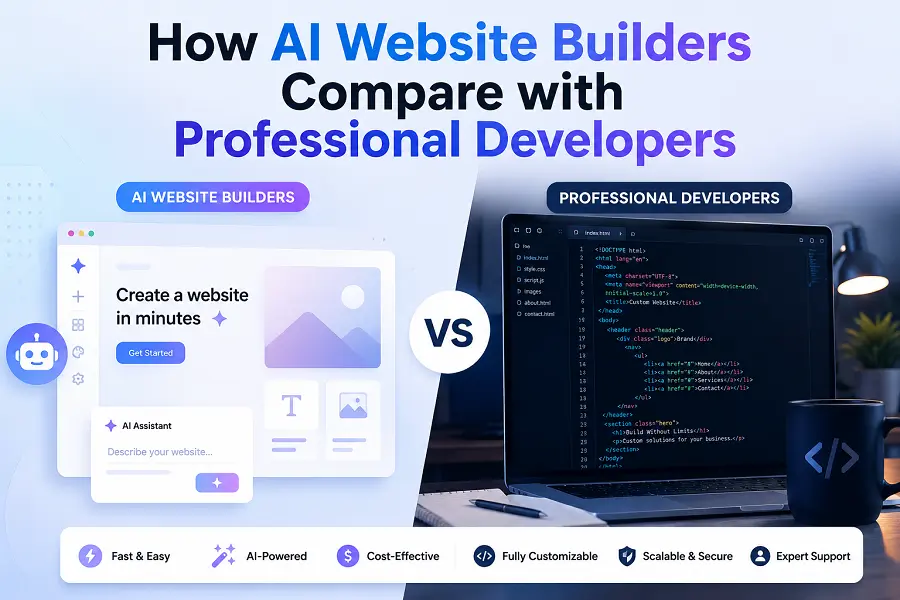
The barrier to entry for establishing a digital storefront has collapsed. With the evolution of algorithmic design, the choice between utilizing an artificial intelligence website builder and hiring a professional developer has become a pivotal strategic decision for businesses. While machine learning tools offer unprecedented speed and near-zero upfront costs, human engineers provide bespoke architecture, advanced technical optimization, and unique brand differentiation. Understanding the deep functional boundaries between these two approaches determines whether a website can scale, rank, and successfully convert traffic.
Evaluating Code Overhead and Core Web Vitals Performance
The underlying architecture of a digital platform directly influences how search engines perceive and rank your content. Automated generators and traditional bespoke programming approach script compilation from entirely different engineering philosophies.
-
Bloated Common Frameworks: Automated systems bundle excessive, multi-purpose scripts designed to fit every conceivable business niche, creating heavy page weight.
-
Streamlined Code Delivery: Expert human developers write clean, semantic HTML and modular CSS, compiling only the exact scripts required for your specific features.
-
Render-Blocking Obstacles: Machine-generated layouts frequently suffer from unoptimized loading paths, which trigger structural layout shifts on mobile devices.
-
Server-Side Edge Optimization: Experienced software engineers implement granular caching protocols and shave milliseconds off the time to first byte through custom hosting environments.
Navigating the Boundaries of SEO and Structural Search Compliance
Launching a visually appealing interface is only half the battle; the platform must be mathematically optimized for discovery. While automated tools handle baseline meta tags smoothly, they often hit an immediate ceiling when faced with intricate, semantic optimization criteria.
-
Custom Schema Graph Architecture: Professional developers build interconnected, multi-layered microdata structures tailored to local business schemas and voice search footprints.
-
Intentional Internal Link Networks: Humans build deliberate information hubs that distribute crawling authority predictably, whereas software algorithms tend to link pages linearly or randomly.
-
Advanced Answer Engine Preparation: Tailoring codebases to feed contextual data to generative search overviews requires an intuitive understanding of natural human language hierarchies.
-
Localized Search Signal Customization: Human engineers fine-tune code footprints to reflect highly specific regional parameters, accelerating placement in regional map packs.
Managing Complex Integration, Security, and Scalability Ceilings
As a digital enterprise expands, its operational requirements shift from simple text display to complex data orchestration. This structural transition exposes the ultimate divergence between rigid template software and open-ended engineering.
A basic landing page or portfolio operates comfortably within a hosted automated environment. However, once a business requires deep customer relationship management synchronizations, proprietary payment systems, or multi-role client portals, automated builders struggle. These platforms lack the flexibility to construct custom application programming interfaces (APIs) or securely manage isolated data pipelines.
Furthermore, algorithmic code generation introduces a substantial security margin of error, occasionally introducing unrecognized vulnerabilities into server environments. A professional software developer approaches security from a stance of threat modeling, writing custom authentication flows and maintaining complete ownership of the source code. This eliminates platform lock-in and ensures the asset can scale infinitely as corporate workflows evolve.
Conclusion
The decision between an automated construction platform and a professional engineer hinges entirely on your long-term business objectives. For validating an immediate idea, creating a placeholder, or launching a basic brochure site, automated systems provide unmatched efficiency. However, when a platform serves as a primary engine for customer acquisition, data processing, and brand authority, investing in a custom-engineered solution ensures the technical superiority, security, and search discoverability required for sustained growth.
FAQs
Can an automated platform match the visual design quality of a professional developer?
Yes, for standard layouts, modern automated platforms generate clean, highly responsive, and visually polished aesthetics that match professional visual standards.
Why do custom-built websites generally score higher on performance testing tools?
Custom sites contain zero filler script. Every line of code is handwritten for that specific project, resulting in faster rendering speeds and superior Core Web Vitals.
How do professional developers approach data security differently than automated tools?
Developers build isolated database structures, implement custom encryption protocols, and avoid the shared platform plugins that hackers frequently target.
Is it possible to migrate a website out of an automated builder later?
Most automated platforms utilize locked, proprietary hosting ecosystems, meaning you cannot easily export the underlying code to another server without rebuilding.
Which option is more cost-effective for a local service business?
An automated builder is highly cost-effective for an initial launch, but a custom site yields a higher return on investment over time via superior search visibility.