

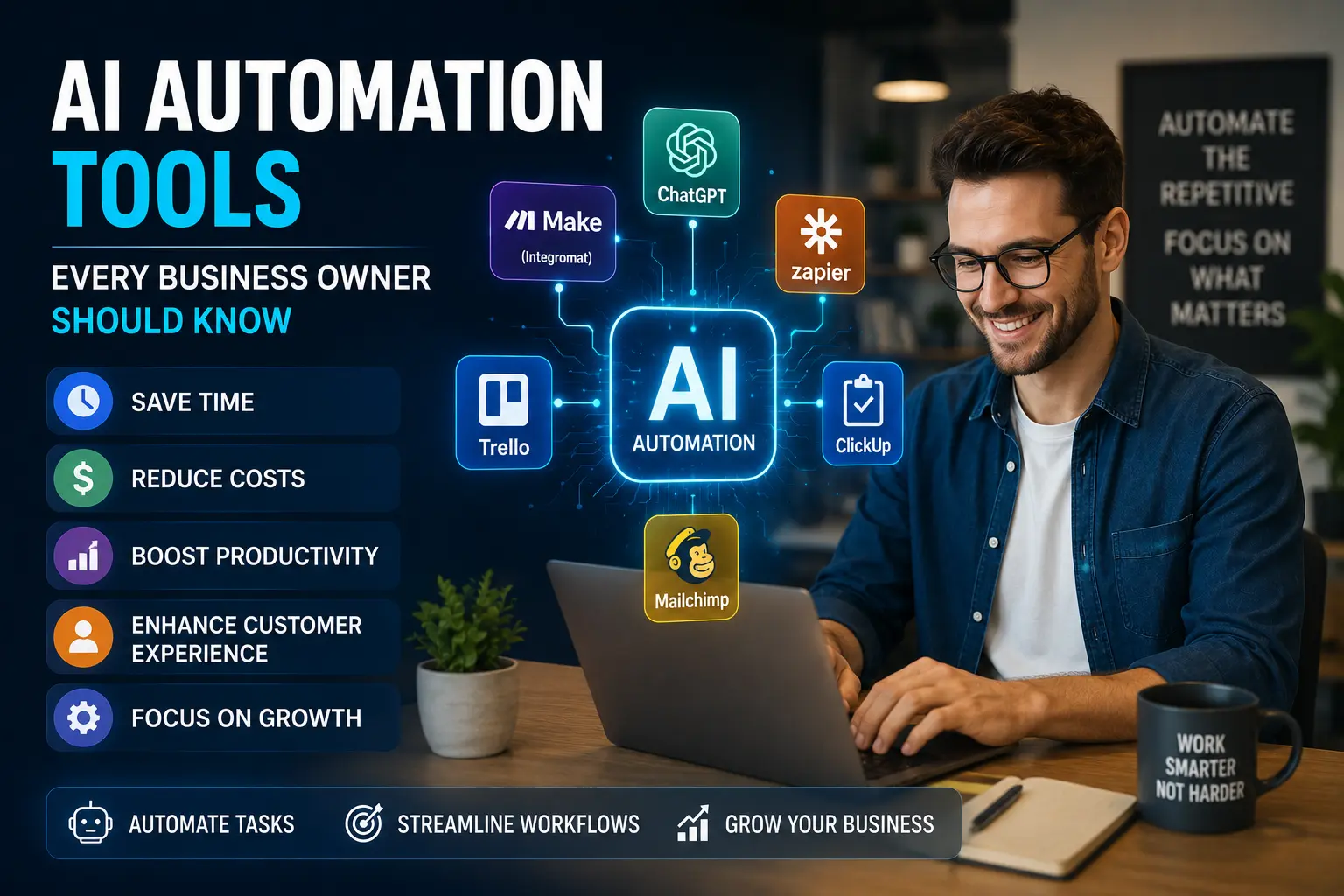
Running a business means wearing too many hats at once. Between managing customers, handling operations, and trying to grow revenue, the hours disappear fast. AI automation tools are changing that equation — not by replacing business owners, but by handling the repetitive, time-consuming tasks that drain energy without driving growth.
The tools covered here are practical, accessible, and already being used by businesses of every size.
AI Tools That Automate Customer Communication
Customer interaction is one of the highest-volume, most time-intensive parts of running any business. AI has made it possible to maintain responsive, personalized communication at scale — without a large support team.
- AI chatbots handle website inquiries, answer frequently asked questions, qualify leads, and book appointments around the clock without human intervention
- Email automation platforms use AI to segment audiences, personalize subject lines, and send messages at optimal times based on individual user behavior
- AI-powered CRM systems automatically log customer interactions, predict follow-up timing, and flag high-priority leads before they go cold
- Sentiment analysis tools scan customer reviews, support tickets, and social mentions to identify dissatisfied customers early — allowing faster resolution
- Automated review response tools generate contextually appropriate replies to customer feedback, maintaining a professional online reputation without manual effort
- Voice AI assistants answer inbound calls, collect caller information, and route inquiries to the right team member without a receptionist
Together, these tools create a customer experience that feels attentive and responsive — even when the business owner is focused elsewhere.
Workflow and Operations Automation Every Owner Should Implement
Beyond customer-facing tasks, the internal mechanics of running a business consume significant time. AI automation tools targeting operations deliver some of the highest returns on investment available.
- AI scheduling assistants eliminate the back-and-forth of booking meetings by syncing calendars, proposing times, and sending confirmations automatically
- Document automation tools generate contracts, proposals, and invoices from templates using pre-filled business data — cutting document preparation from hours to minutes
- AI-powered project management platforms assign tasks based on team capacity, predict project delays before they happen, and surface bottlenecks in real time
- Automated bookkeeping software categorizes transactions, reconciles accounts, and prepares financial summaries without manual data entry
- Inventory management AI analyzes sales velocity and seasonal trends to trigger reorder alerts before stock runs out
- HR automation tools screen job applications, schedule interviews, and send onboarding documents without recruiter involvement at every step
Each of these addresses a process that previously required dedicated staff or significant owner time. Automating even two or three of them creates meaningful capacity to focus on higher-value work.
AI Marketing Automation Tools That Drive Consistent Growth
Marketing is where AI automation delivers perhaps its most visible impact. Consistency and personalization — two things manual marketing struggles to maintain simultaneously — are precisely what AI handles best.
Content creation tools now assist with drafting blog posts, social media captions, ad copy, and product descriptions at a pace no human writer can match alone. They don’t replace creative judgment, but they eliminate the blank-page problem and compress production time significantly.
AI ad optimization platforms monitor campaign performance in real time, reallocating budget toward the highest-performing audiences and pausing underperforming creatives automatically. Business owners no longer need to check dashboards daily to prevent wasted ad spend.
SEO automation tools identify keyword gaps, analyze competitor content, and recommend on-page improvements — translating what used to require an agency into actionable suggestions any owner can implement.
Social media scheduling tools with AI features suggest optimal posting times, recommend content formats based on engagement history, and even repurpose long-form content into short clips or carousel posts.
The cumulative effect is a marketing operation that runs with far more consistency than most small teams could manually sustain.
Choosing the Right Tools Without Overcomplicating the Stack
The risk with AI automation isn’t in adopting it — it’s in adopting too much too fast. A business owner who installs ten tools simultaneously and integrates none of them properly gains less than one who implements two tools deeply and builds reliable workflows around them.
Start by identifying the single process that consumes the most time for the least strategic return. Automate that first. Measure the time saved. Then expand.
The businesses seeing the greatest results from AI automation aren’t necessarily using the most tools — they’re using the right ones consistently.
Frequently Asked Questions
Q: What is the best AI automation tool for a small business just getting started?
Email automation combined with a basic AI chatbot covers two of the highest-volume tasks immediately — customer communication and lead follow-up — making them the strongest starting point.
Q: Are AI automation tools expensive for small businesses?
Most entry-level AI automation tools are priced between $20 and $100 per month. Many offer free tiers with enough functionality to automate core tasks before committing to a paid plan.
Q: Can AI automation tools work together, or do they operate independently?
Most modern AI tools support integrations through platforms that connect different applications. This allows data to flow between tools automatically, creating end-to-end automated workflows without manual handoffs.
Q: Will AI automation reduce the quality of customer interactions?
When configured correctly, AI automation improves response speed and consistency — two factors customers value highly. The key is setting up tools to escalate complex issues to a human rather than attempting to resolve everything automatically.
Q: How long does it take to see results after implementing AI automation?
Most business owners notice measurable time savings within the first two to four weeks of proper implementation. Revenue impact, particularly from marketing automation, typically becomes visible within one to three months.