

Ask any manager who’s sat through a “mandatory training session” and watched half the room quietly check their phones, and they’ll tell you — the way we teach adults is broken more often than it works.
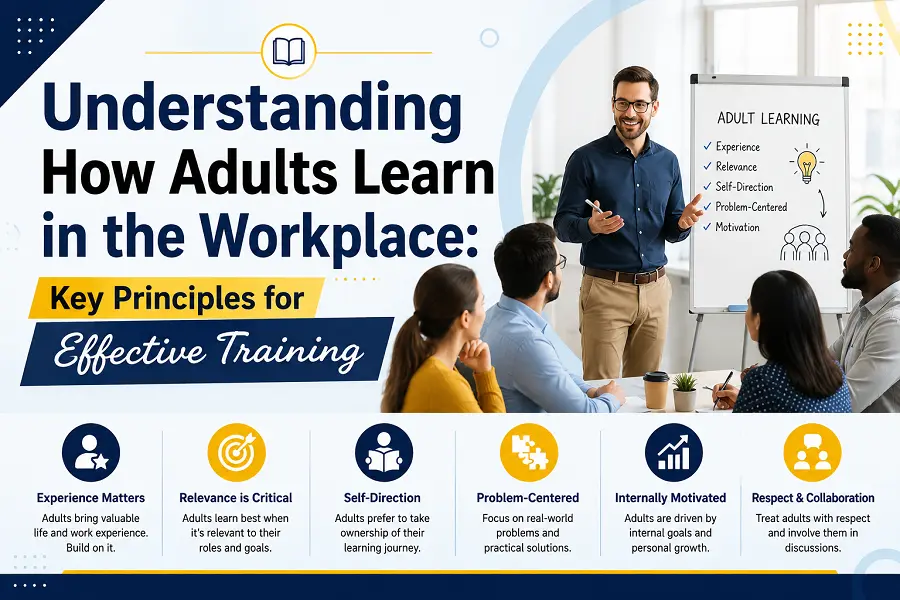
Here’s the direct answer, before we go further: adults learn best when training is relevant to their actual job, respects the experience they already have, and lets them apply what they’re learning right away. That’s it. Everything else in this article is really just detail on how to make that happen.
I’ve sat on both sides of this — as someone who’s designed onboarding programs and as someone who’s sat through painfully generic ones. The difference between a training session people remember and one they forget by lunch usually comes down to whether the trainer understood how adults learn in the workplace, not just what they need to know.
Why Adults Don’t Learn the Way Students Do
A lot of workplace training still looks like a classroom lecture — slides, a quiz, maybe a certificate at the end. The problem is, adults aren’t sitting in that room for a grade. They’re there because it’s Tuesday and someone told them to be.
Malcolm Knowles, the researcher often credited with formalizing adult learning theory (he called it andragogy), pointed out something managers still get wrong decades later: adults need to know why they’re learning something before they’ll actually absorb it. Kids in school often learn because they’re told to. Adults ask, fairly, “what’s in this for me?”
A few things tend to be true across most adult workplace learners:
- They bring real experience to the table, and they’ll tune out content that ignores it
- They want to solve a problem, not memorize a theory
- They learn better through doing than through watching
- They’re juggling the training against actual job pressure, so time matters
- They need to see the payoff — a promotion, an easier workflow, fewer mistakes
I once watched a company roll out a new CRM system with a two-hour lecture and a 40-slide deck. Adoption was terrible. Six months later, a different team lead scrapped that approach and instead gave employees 15 minutes with the tool and a real customer scenario to solve. Same software, completely different result. That’s the difference experience-based learning makes.
How to Train Adults in the Workplace (Without Losing Them by Slide Ten)
So what actually works? A few principles, gathered from what’s held up in practice, not just theory.
Make it relevant, fast
Don’t bury the “why” in slide 30. Tell people up front how this training will make their actual work easier, safer, or faster. If you can’t answer that honestly, the training probably needs rethinking before it needs delivering.
Let them do, not just watch
Adults retain skills better when they practice them, even imperfectly, than when they passively absorb a demo. Role-play a difficult client call. Have them fix a broken spreadsheet formula themselves instead of watching you fix it.
Respect what they already know
Nothing kills engagement faster than a trainer who talks to a room full of 15-year veterans like it’s their first day. Ask questions. Build on what people already bring in.
Break it into pieces
Adults juggling job responsibilities don’t retain a three-hour info dump well. Shorter sessions spaced over days or weeks — sometimes called spaced learning — tend to stick better than one long session.
Give feedback that’s specific
“Good job” teaches nothing. “You handled the objection well, but try acknowledging the client’s frustration before pitching the fix” — that’s something a person can actually act on next time.
None of this is complicated. It just requires treating training design like you’d treat any other workplace process — with attention to what actually gets results, not what’s easiest to schedule on a calendar.
The ADHD Angle: Strengths That Often Get Overlooked
Here’s something worth saying plainly, because it rarely gets said in workplace training conversations: adults with ADHD are often written off as “hard to train” when really, they just need training that isn’t built around sitting still and listening for an hour.
What gets missed is the flip side. Many adults with ADHD bring real strengths to the workplace — quick pattern recognition, high energy during periods of interest, comfort with ambiguity, and a willingness to take entrepreneurial risks that more risk-averse colleagues avoid. It’s not a coincidence that a noticeable number of founders and entrepreneurs describe themselves as having ADHD; the same traits that make a nine-to-five structure frustrating can translate into genuine advantages when someone’s building something on their own terms — fast decision-making, creative problem-solving under pressure, and an ability to hyperfocus on the right project at the right moment.
For training purposes, this means giving people options: shorter modules, the ability to move around, hands-on tasks instead of passive lectures, and clear, written follow-up instead of only verbal ones. It’s not about lowering the bar — it’s about not accidentally filtering out capable people because the training format doesn’t fit how their brain works.
When Learning Breaks Down: Adult Bullying at Work
No article on workplace learning is complete without mentioning the thing that quietly undermines it: adult bullying at work.
You can build the best training program in the world, but if someone’s afraid to ask a question in front of a colleague who mocks mistakes, or if a manager plays favorites and freezes out anyone who challenges them, learning stops. People stop practicing new skills in front of others because it feels unsafe to fail.
Why do adults bully in the workplace? It’s rarely about the target — it’s usually about control, insecurity, or a culture that’s quietly rewarded aggressive behavior for so long nobody questions it anymore. Sometimes it’s a manager who mistakes intimidation for leadership. Sometimes it’s a peer group protecting territory. Whatever the cause, the effect on training is the same: people disengage, stop asking questions, and stop growing.
If you’re responsible for training in your organization, it’s worth asking honestly whether your workplace culture actually supports people trying, failing, and trying again — because that’s the environment adult learning needs to work at all.
A Realistic Caveat
None of this guarantees results. Even well-designed training fails if there’s no follow-up, no manager reinforcement, or no time built in to actually practice what was taught. Adult learning principles help — they’re not magic. The businesses that see real change are the ones that treat training as an ongoing process, not a one-day event.
5. FAQs
1. How do adults learn differently than children in the workplace?
Adults learn best when training connects to real problems they face, whereas children often learn structured content regardless of immediate relevance.
2. What is andragogy?
Andragogy is the study of how adults learn, as distinct from pedagogy, which focuses on children’s education.
3. How to train adults in the workplace effectively?
Focus on relevance, hands-on practice, respecting prior experience, and breaking content into shorter, spaced sessions.
4. Why don’t adults respond well to lecture-style training?
Because adults are motivated by problem-solving and immediate application, not passive information intake.
5. What are common signs that workplace training isn’t working?
Low engagement, poor retention, disinterest during sessions, and no visible change in behavior afterward.
6. Do adults with ADHD struggle more with workplace training?
Not necessarily — they often struggle more with rigid, lecture-heavy formats, not with learning itself.
7. What strengths do ADHD adults bring to the workplace?
Quick thinking, comfort with risk, creative problem-solving, and strong performance during periods of high interest.
8. Why are many entrepreneurs said to have ADHD traits?
Traits like fast decision-making and comfort with ambiguity can translate well into entrepreneurial environments.
9. Why do adults bully in the workplace?
Often due to insecurity, desire for control, or a workplace culture that has tolerated aggressive behavior unchecked.
10. How does workplace bullying affect learning?
It creates fear of failure, discouraging employees from asking questions or practicing new skills openly.
11. What is adult bullying at work most commonly linked to?
Power dynamics, favoritism, and unaddressed toxic management behavior.
12. How long should adult training sessions be?
Shorter, focused sessions spaced over time generally work better than long, single sessions.
13. What role does feedback play in adult learning?
Specific, actionable feedback helps adults improve, while vague praise or criticism does little.
14. Can workplace culture affect how well adults learn?
Yes — a safe, respectful culture is essential for adults to practice and apply new skills without fear.
15. Is one-time training enough for adults to retain new skills?
No — ongoing reinforcement and practice are usually necessary for lasting change.