

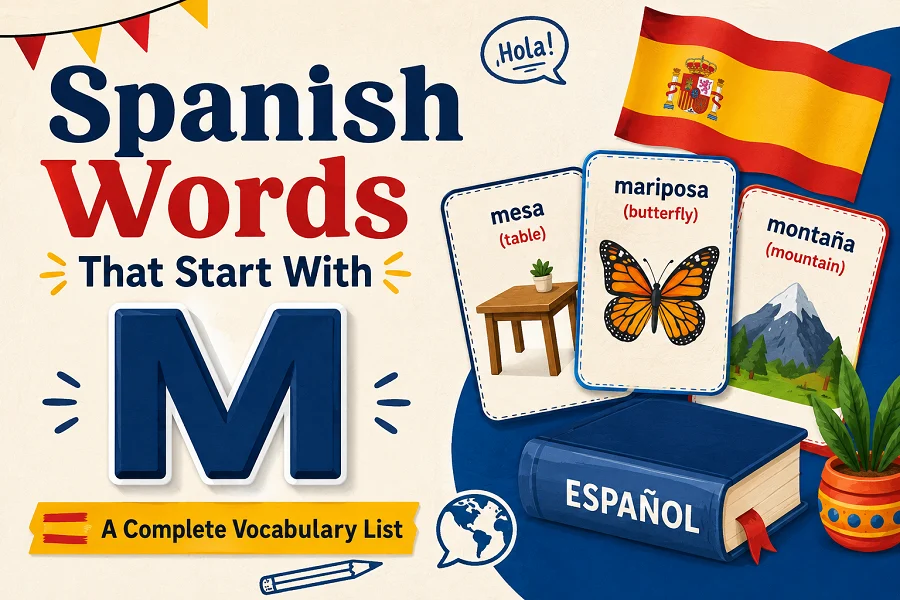
The letter M is one of the most generous letters in Spanish. Ask any teacher, and they’ll tell you M-words show up constantly in beginner textbooks — mesa, madre, mano — because they’re short, they’re common, and honestly, they’re just easy to say out loud. That’s not an accident. A lot of Spanish nouns that start with M describe things we talk about every single day: family, food, the human body, the calendar.
I’ve spent years helping students build vocabulary lists like this one, and M always ends up being a favorite letter to teach. It’s phonetically friendly for English speakers — there’s no tricky rolled R, no confusing silent letters — so it builds confidence fast. Below, you’ll find a working list organized by category, plus a section on adjectives and Spanish places, since those two searches come up a lot too.
Quick Answer: Common Spanish Words Starting With M
If you’re in a hurry and just need a solid starter list, here it is. These are the words that show up most often in everyday conversation, textbooks, and beginner apps:
- madre – mother
- mano – hand
- mesa – table
- mañana – tomorrow / morning
- mundo – world
- mujer – woman
- mar – sea
- mes – month
- mercado – market
- médico – doctor
- mochila – backpack
- muchacho/a – boy/girl
- millón – million
- mismo – same
- maleta – suitcase
That’s the shortlist. Now let’s break it down properly, because M-words fall into some pretty distinct categories, and knowing the pattern actually makes them easier to remember.
M Words in Spanish: Nouns You’ll Actually Use
Nouns make up the bulk of any vocabulary list, and Spanish is no exception. Here’s a wider set, grouped loosely by how often you’d hear them in real conversation.
People and family madre (mother), marido (husband), mujer (woman/wife), muchacho (boy), mellizo (twin), maestro (teacher), médico (doctor)
Everyday objects mesa (table), mochila (backpack), maleta (suitcase), moneda (coin), manta (blanket), máquina (machine), martillo (hammer)
Time and nature mañana (tomorrow/morning), mes (month), minuto (minute), mar (sea), montaña (mountain), mundo (world), madera (wood), musgo (moss)
Food-related manzana (apple), mantequilla (butter), maíz (corn), melón (melon), miel (honey), mermelada (jam)
A small tip here — one I give my own students constantly — is that mano (hand) is one of the few Spanish nouns ending in -o that’s actually feminine (la mano, not el mano). It trips up almost everyone at first. If you only remember one exception from this whole article, make it that one.
Adjectives in Spanish That Start With M
Adjectives are where M really pulls its weight, since so many describing words in Spanish happen to start with this letter.
- malo/a – bad
- mayor – older, bigger
- menor – younger, smaller
- moreno/a – dark-haired/tan
- mojado/a – wet
- maravilloso/a – wonderful
- molesto/a – annoying, bothered
- mediano/a – medium
- mismo/a – same
- misterioso/a – mysterious
- magnífico/a – magnificent
- mentiroso/a – lying, dishonest
- musical – musical
- moderno/a – modern
- materno/a – maternal
Notice the pattern? Most Spanish adjectives ending in -o/-a change based on gender (malo for masculine, mala for feminine), while ones ending in -al or consonants like musical stay the same either way. That single rule saves a lot of memorization headaches once it clicks.
Places in Spain Starting With M
This one surprises people — Spain has quite a few well-known cities, towns, and regions that begin with M, and a couple of them are places you’ve probably already heard of even if you’ve never studied a word of Spanish.
- Madrid – the capital city, obviously the big one
- Málaga – coastal city in Andalusia, known for beaches and Picasso’s birthplace
- Murcia – a region and city in the southeast
- Mallorca – the largest of the Balearic Islands
- Menorca – another Balearic island, quieter than Mallorca
- Marbella – upscale resort town on the Costa del Sol
- Melilla – a Spanish autonomous city on the North African coast
If you’re planning a trip or just building general knowledge for a Spanish class project, this list is worth bookmarking on its own — geography questions come up constantly in intermediate-level Spanish courses.
Why Learning M-Words Is a Smart Place to Start
Here’s something most vocabulary lists won’t tell you: the letter M isn’t just common — it’s genuinely useful in a disproportionate way. Words like mucho (a lot), más (more), mejor (better), and muy (very) are quantity and comparison words you’ll need in nearly every sentence once you move past basic greetings. You genuinely can’t have a real conversation in Spanish without leaning on a handful of M-words within the first few exchanges.
I’ve noticed with my own students that once they get comfortable with más and mucho, their sentences start sounding less like a phrasebook and more like actual speech. That’s a small thing, but it matters for confidence.
A Few Words That Look Similar (Don’t Mix These Up)
A quick caveat, since this trips people up more than you’d expect:
- mas (without an accent) means “but” — it’s old-fashioned and rare now, mostly seen in poetry or formal writing
- más (with an accent) means “more”
- mí (with an accent) means “me”
- mi (without an accent) means “my”
These accent marks aren’t decorative — they change meaning entirely. It’s a small detail, but it’s exactly the kind of thing that separates a decent Spanish speaker from a great one.
How to Actually Remember These Words
Flashcards work, but they’re not the whole story. What’s helped my students more is grouping words by theme — like I did above — rather than trying to memorize a flat alphabetical list. The brain holds onto “family words” or “kitchen words” much better than a random string of M-terms with no connection to each other.
One more practical tip: try writing three sentences a day using just one new M-word each. It doesn’t need to be complicated. “La mesa es grande” (the table is big) is enough. Repetition in context beats rote memorization almost every time.
Frequently Asked Questions
1. What are some easy Spanish words that start with M?
Mano (hand), mesa (table), madre (mother), and mundo (world) are among the simplest and most commonly used.
2. How many Spanish words start with M?
Thousands, honestly — M is one of the more productive letters in Spanish. This list covers the most useful ones for everyday conversation, not the full dictionary.
3. What does “mañana” mean in Spanish?
It has two meanings depending on context: “tomorrow” or “morning.” Buenos días means good morning, but por la mañana means “in the morning.”
4. Is “mano” masculine or feminine in Spanish?
Feminine — la mano — even though it ends in -o. It’s one of the well-known exceptions to the usual gender rule.
5. What are some Spanish adjectives that start with M?
Malo (bad), mayor (older), moreno (dark-haired), misterioso (mysterious), and moderno (modern) are common examples.
6. What Spanish cities start with M?
Madrid, Málaga, Murcia, Marbella, and Melilla are among the most recognized.
7. What does “más” mean in Spanish?
“More.” It’s used constantly, as in más agua (more water) or más tarde (later).
8. Are “mas” and “más” the same word?
No. Mas (no accent) means “but” and is rarely used today. Más (with accent) means “more” and is very common.
9. What is a good M-word for beginners to learn first?
Mucho (a lot/much) and más (more) are extremely useful early on since they show up in nearly every conversation.
10. What does “muchacho” mean?
It means “boy” or “young man.” The feminine form is muchacha (girl/young woman).
11. Is there a difference between “mi” and “mí”?
Yes. Mi (no accent) means “my,” while mí (with accent) means “me,” usually after a preposition like para mí (for me).
12. What’s the Spanish word for “market”?
Mercado.
13. What Spanish word means “world”?
Mundo.
14. Are Spanish M-words hard to pronounce for English speakers?
Not usually. M is one of the more approachable letters for English speakers since the sound is nearly identical in both languages.
15. Where can I practice using these M-words in sentences?
Try writing short daily sentences, use language apps with spaced repetition, or practice with a native speaker through a language exchange app — context-based practice sticks far better than flashcards alone.