

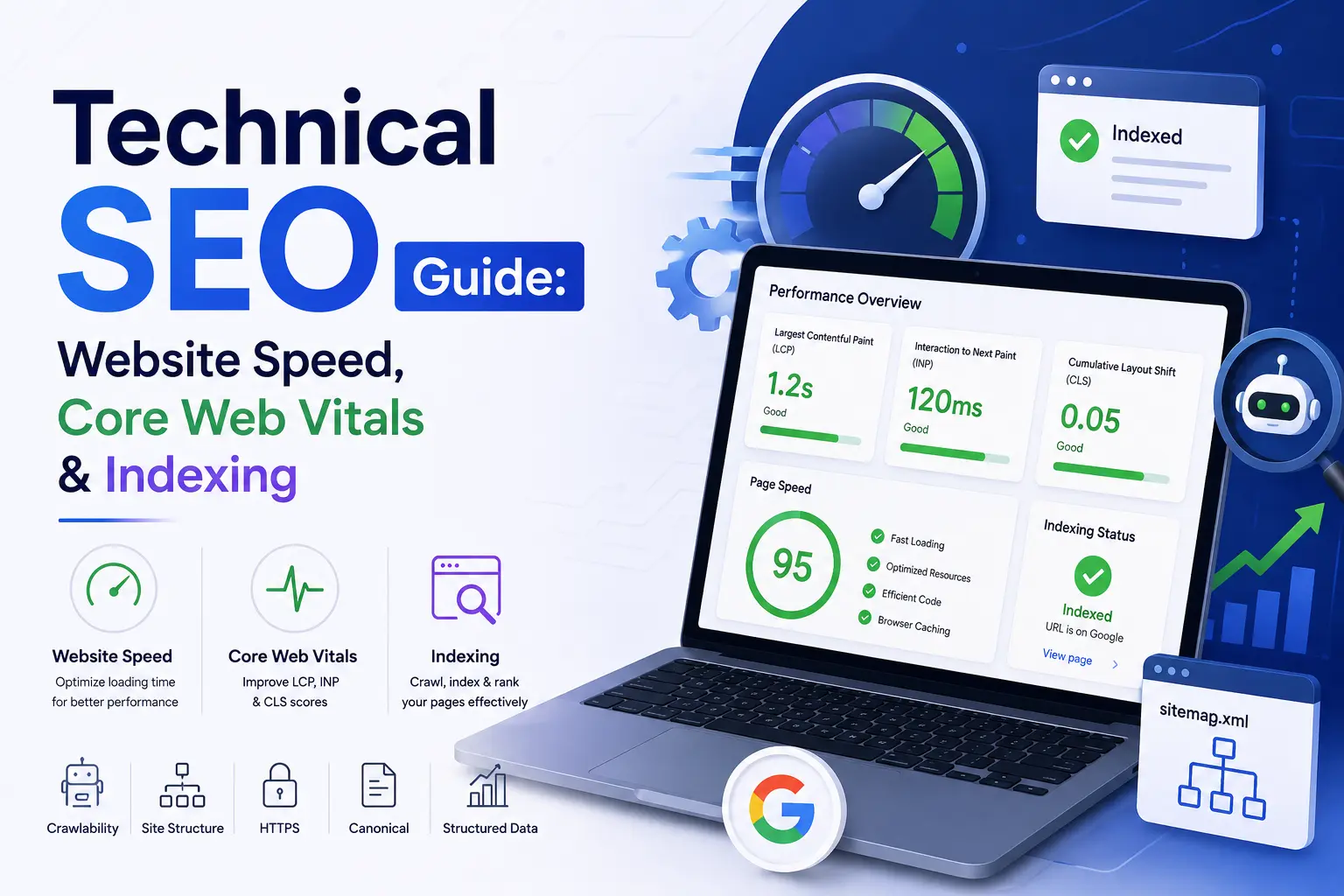
The framework of organic search distribution relies heavily on infrastructural health. While high-quality text satisfies user intent, an unstable technical foundation prevents search engine crawlers from discovering, parsing, and rendering your pages correctly. If a website suffers from severe latency or indexing blocks, even expert-level content will fail to surface in organic results, featured snippets, or AI summaries.
Optimizing a website for modern visibility requires a deep focus on speed metrics, real-world layout stability, and crawl path efficiency. Addressing these mechanical components removes communication barriers between your server and automated search systems.
1. Mastering Modern Core Web Vitals Performance
Evaluating user experience involves real-world field data collected from actual human interactions. Search performance systems penalize domains that exhibit heavy layout shifts or severe input delay during page rendering.
-
Largest Contentful Paint (LCP): This metric tracks the time it takes for the primary visual element, like a hero image or heading, to render on the screen. Target a loading speed under 2.5 seconds by implementing server-side caching and optimizing visual assets.
-
Interaction to Next Paint (INP): Tracking user interface responsiveness, this metric measures the delay between a user clicking a link or button and the browser executing the visual update. Keep this processing window below 200 milliseconds to avoid user experience penalties.
-
Cumulative Layout Shift (CLS): Visual stability prevents accidental clicks caused by unexpected layout jumps. Ensure a shift score below 0.1 by defining explicit height and width dimensions for all embedded elements, media files, and script containers.
-
Time to First Byte (TTFB): Server response delays stall the entire rendering pipeline. Minimizing database lookup times, utilizing high-performance hosting, and deploying a globally distributed content delivery network shortens this initial connection gap.
2. Streamlining Crawler Access and Indexing Pathways
A disorganized directory layout wastes your technical crawling resources on administrative pages, duplicate session URLs, and low-value parameters. Managing your server’s accessibility configuration ensures search bots dedicate their time to your primary conversion pages.
To optimize your site’s indexing health, implement this technical workflow:
-
Enforce Absolute Canonical Configurations: Implement self-referencing canonical tags on every unique URL to prevent sorting filters or tracking parameters from generating duplicate indexing errors.
-
Optimize the Robots.txt File Path: Restrict search bots from entering administrative directories, internal checkout loops, and sensitive backend folders to save your allocation budget.
-
Construct Dynamic XML Sitemaps: Build clean, automated maps that contain only indexable, high-value pages, completely removing any URLs that produce redirect loops or 404 server errors.
-
Resolve Server-Side Redirect Chains: Eliminate progressive forwarding patterns where one link points to a second redirect before loading, ensuring all internal references connect straight to the final destination.
3. Eliminating Script Execution and Rendering Bottlenecks
Modern web development often relies on heavy code frameworks that run entirely within the user’s browser window. This setup creates hidden processing walls for search crawlers. When a search engine bot encounters complex, unoptimized scripts, it may time out before reading the page text, resulting in a blank or unindexed page.
To prevent rendering failures, prioritize server-side processing for your core text elements. Defer non-essential scripts so they execute only after the primary text layout has loaded on the screen. Compressing style rules, removing unused code blocks, and using modern asset delivery methods prevents script execution lag, allowing automated systems to quickly index your full value proposition.
Conclusion
Sustained search ranking requires a balance between editorial depth and absolute technical precision. By maintaining stable layout performance, eliminating script rendering barriers, and creating clear crawling paths, your domain builds the mechanical foundation necessary to hold top organic search positions.
Frequently Asked Questions
What causes a high Cumulative Layout Shift on mobile viewports?
Layout shifts usually happen when images, fonts, or ad banners load without predefined dimensions. This causes the browser to recalculate the page layout on the fly, moving text unexpectedly while a user reads.
How does Interaction to Next Paint differ from traditional input delay?
Traditional input delay only measured the latency of the very first click on a page. The modern metric evaluates the response speed of all interactive points throughout the entire duration of a user’s visit.
Why do pages with 301 redirects drain a site’s crawl budget?
Every redirect requires search bots to make an extra server request. When a site has long redirect chains, crawlers waste their processing limits on empty jumps instead of discovering new content.
Can search engines index content hidden inside accordion menus?
Yes, search bots can parse text inside expandable accordion tabs, provided the content is present in the source HTML on load and does not require complex user clicks to generate the code.
How does a content delivery network improve website speed?
A content delivery network stores cached copies of your static website files on a global network of servers. It serves these files from the data center closest to the user’s physical location, lowering latency.