
A bridge collapses in a simulation. Engineers analyze the failure, adjust the design, and fix the flaw — before a single beam is welded in the real world. That scenario is exactly what digital twins technology makes possible. By creating precise virtual replicas of physical objects, systems, or processes, organizations can test, monitor, and optimize without touching the original. The concept sounds futuristic, but it’s already embedded in aerospace, healthcare, manufacturing, and urban planning worldwide.
What a Digital Twin Actually Is and How It Works
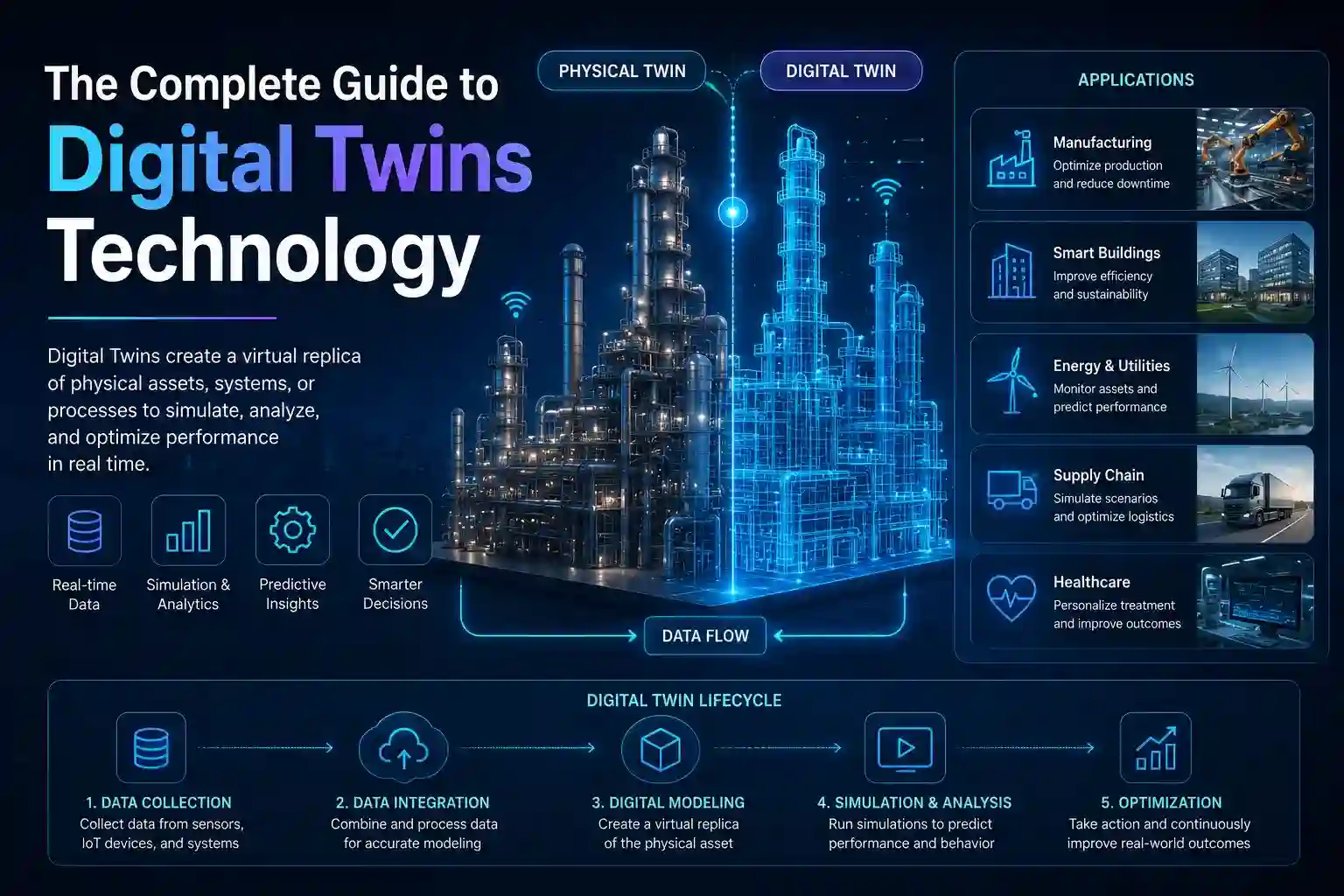
A digital twin is a dynamic virtual model synchronized with its real-world counterpart through continuous data exchange. Unlike a static 3D rendering or a basic simulation, a digital twin updates in real time — reflecting current conditions, behaviors, and performance metrics from the physical object it mirrors.
The architecture behind this connection typically involves three components working together:
- Physical sensors embedded in the real-world asset collect live data — temperature, pressure, vibration, wear patterns, throughput, and more
- Data integration layer transmits sensor readings to the virtual model via IoT connectivity, ensuring the twin reflects actual conditions rather than theoretical ones
- Simulation engine processes incoming data to model behavior, run what-if scenarios, and project future states based on current trajectories
- Analytics and AI layer identifies anomalies, predicts failures, and surfaces optimization opportunities that would be invisible to manual inspection
- Feedback loop allows decisions made in the virtual environment — adjusted parameters, modified workflows — to be applied back to the physical system
- Visualization interface presents the twin as an interactive dashboard or 3D environment where operators can explore data spatially rather than through raw numbers
This closed loop between physical reality and digital representation is what separates a true digital twin from conventional modeling software.
Industries Where Digital Twins Deliver Measurable Results
The technology isn’t confined to a single sector. Its value scales wherever complex physical systems require continuous monitoring, expensive downtime must be avoided, or design decisions carry high stakes.
- Manufacturing uses digital twins of production lines to identify bottlenecks, simulate retooling scenarios, and predict equipment failures before they halt operations — cutting unplanned downtime by identifying stress points weeks in advance.
- Aerospace and defense applies twin technology to aircraft engines, allowing engineers to monitor component wear across entire fleets simultaneously and schedule maintenance based on actual condition rather than fixed intervals.
- Healthcare creates patient-specific organ twins that help surgeons rehearse complex procedures, predict how a patient will respond to a drug, and personalize treatment plans based on individualized physiological models.
- Smart cities deploy infrastructure twins covering water networks, electrical grids, and traffic systems — enabling planners to simulate the impact of population growth or extreme weather on city services before committing to capital projects.
- Energy sector operators run twins of wind turbines and oil platforms to optimize energy output and catch mechanical degradation before it escalates into costly equipment replacement.
- Construction and real estate leverage building information modeling enhanced with twin technology to manage structural performance, energy efficiency, and occupant comfort across the full building lifecycle.
- Retail and supply chain organizations model warehouse layouts and logistics networks to test configuration changes, simulate demand surges, and reduce fulfillment errors without disrupting live operations.
Each application shares a common outcome: better decisions made with lower risk, because consequences can be tested virtually before they manifest physically.
The Challenges Organizations Face When Implementing Digital Twins
Despite compelling use cases, deployment is rarely straightforward. The gap between the concept and working implementation involves technical, organizational, and financial friction that teams need to anticipate.
Data quality is the most immediate obstacle. A digital twin is only as accurate as the sensor data feeding it. Poorly calibrated sensors, connectivity gaps, or inconsistent data formats corrupt the model’s fidelity and erode trust in its outputs.
Integration complexity follows closely. Most organizations operate legacy systems that weren’t designed to share data. Connecting older equipment to a twin architecture requires middleware, custom APIs, and sometimes hardware retrofits that add cost and timelines.
Security presents a structural concern. A synchronized twin exposes operational data — production rates, equipment states, infrastructure vulnerabilities — through digital channels. Every access point becomes a potential entry for adversaries seeking to map or disrupt physical operations.
Skill gaps also slow adoption. Building and maintaining a high-fidelity twin requires expertise spanning IoT engineering, data science, domain knowledge, and software architecture — a combination rarely found within a single team.
Addressing these challenges requires phased deployment: starting with a single asset or process, validating the approach, then expanding incrementally.
Conclusion
Digital twins technology bridges physical operations and digital intelligence in a way no previous tool has managed. The ability to simulate failure before it occurs, optimize performance without interrupting production, and test major decisions in a consequence-free environment represents a genuine competitive advantage. As sensor costs fall and AI-powered analytics mature, the barrier to adoption continues to drop — making digital twins less a luxury of large enterprises and more a standard capability across industries of every size.
Frequently Asked Questions
Q1: What is the difference between a digital twin and a simulation?
A simulation runs a model based on predefined assumptions. A digital twin continuously updates from real-world sensor data, meaning it reflects actual current conditions rather than theoretical scenarios — making its outputs far more operationally relevant.
Q2: How much does it cost to implement a digital twin?
Costs vary enormously based on asset complexity, data infrastructure requirements, and desired fidelity. Simple equipment twins can be implemented for tens of thousands of dollars; city-scale or aerospace-grade twins can require multi-million-dollar investments over several years.
Q3: Can small and mid-sized businesses benefit from digital twins?
Yes. Cloud-based twin platforms have significantly reduced entry costs, allowing smaller manufacturers, building operators, and logistics companies to implement asset-level twins without building bespoke infrastructure from scratch.
Q4: How do digital twins support predictive maintenance?
By continuously analyzing sensor data against performance baselines, a digital twin detects early indicators of component degradation — vibration changes, temperature spikes, efficiency drops — and triggers maintenance alerts before failure occurs, replacing calendar-based servicing with condition-based scheduling.
Q5: What role does AI play in digital twin technology?
AI processes the large volumes of sensor data flowing into a twin, identifies patterns human analysts would miss, runs predictive models at scale, and in some implementations autonomously adjusts physical system parameters based on what the twin reveals — closing the loop between insight and action.