

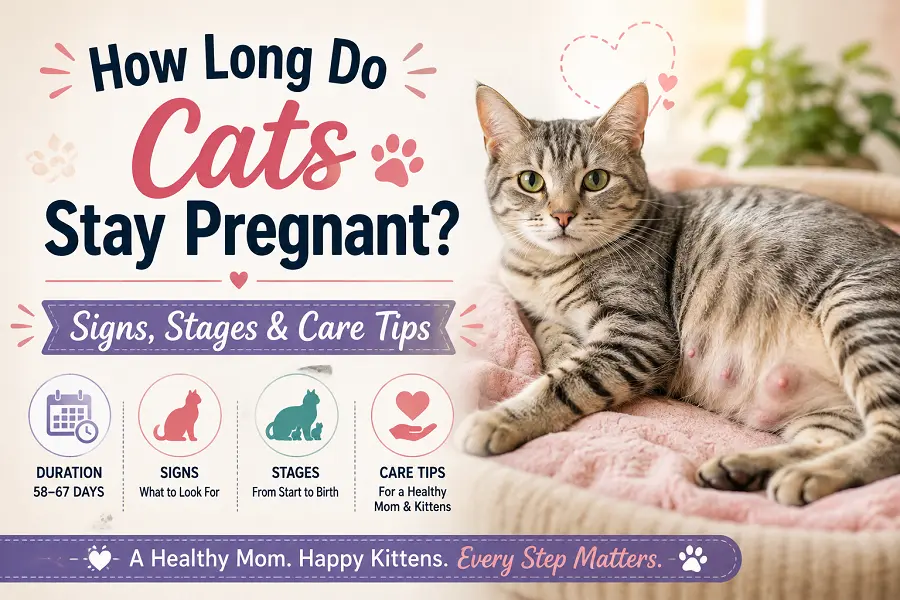
My neighbor’s tabby, Coco, went missing for two days last spring. When she finally strolled back into the yard, she looked… different. Rounder. Slower. A little more particular about where she napped. Two months later, there were four kittens tucked into a laundry basket in the garage.
If you’re here because you suspect your own cat might be in the same situation, I’ll give you the short answer first, then walk through everything else you actually need to know.
Cats are pregnant for about 63 to 65 days — roughly nine weeks, give or take a few days on either side. Some queens (that’s the proper term for a female breeding cat) deliver as early as day 61, others go as long as day 70. Anything past that and it’s worth a call to your vet.
That’s the number people are searching for when they type in “how long are cats pregnant for” or “cat how long pregnant.” But the number alone doesn’t tell you much if you don’t know what’s actually happening during those nine weeks, or how to tell if your cat is pregnant in the first place. Let’s get into it.
So, How Long Is a Cat Pregnant, Exactly?
The average feline gestation period lands at 63–65 days, which is close to two months. Compare that to dogs (about 63 days too, funnily enough) or humans (280 days), and cats are on the faster end of the mammal spectrum. Makes sense, evolutionarily — a stray cat needs to reproduce quickly and often to keep the population going.
A few things that can nudge the timeline:
- First-time mothers sometimes deliver a day or two earlier than experienced queens.
- Litter size matters. A cat carrying six kittens may deliver slightly earlier than one carrying two, simply because there’s less room to work with.
- Breed can play a small role. Some anecdotal reports (and a few breeders I’ve spoken with over the years) suggest Siamese and other Oriental breeds run a touch longer than average, though nothing dramatic — maybe a day or two.
If your cat is still pregnant past day 70 with no sign of labor, don’t wait it out. That’s a vet visit, not a “let’s see what happens” situation.
The Stages of Cat Pregnancy (Week by Week)
Unlike humans, cats don’t get a neat trimester system with obvious milestones you can circle on a calendar. But there is a general rhythm to it.
Weeks 1–2: Almost nothing to see from the outside. Internally, fertilization and implantation are happening. Your cat might seem a little more affectionate, or oddly, a little more withdrawn. Every cat’s different.
Weeks 3–4: This is usually when “pinking up” happens — the nipples become noticeably darker and larger. This is one of the most reliable early visual cues, and honestly, it’s the first thing most experienced breeders check for. Morning sickness-like symptoms (mild vomiting, reduced appetite) can show up around this time too, though not every cat gets them.
Weeks 5–6: The belly starts to round out. Weight gain becomes obvious. Appetite typically increases — sometimes dramatically. You’ll notice she’s eating more and sleeping more.
Weeks 7–8: Kittens are now large enough that you may actually see or feel movement if you rest a hand gently on her belly (ask your vet before doing this — pressing on a pregnant cat’s abdomen isn’t something to do casually). Nesting behavior kicks in here too. Coco, the tabby I mentioned, started dragging towels into the garage around this point, which in hindsight was a pretty clear signal.
Week 9 (Days 63–65): Labor. Restlessness, pacing, vocalizing, and a drop in body temperature are the classic pre-labor signs. Some cats hide. Some seek out their owners constantly. There’s no universal script.
Early Signs Your Cat Might Be Pregnant
Before you even get a vet confirmation, here’s what tends to show up first, roughly in order:
- Nipples turn pink and enlarge (2–3 weeks in)
- Appetite increases noticeably
- Weight gain, especially around the midsection
- Behavioral shifts — more affectionate, or the opposite
- Occasional vomiting (mild, infrequent — not constant)
- Visible belly rounding (5–6 weeks)
- Nesting behavior (final 1–2 weeks)
A vet can confirm pregnancy through abdominal palpation as early as 3–4 weeks, or via ultrasound around day 21, which also gives an early read on litter size. Blood tests (relaxin hormone tests) are another option, usually accurate from around day 20 onward.
What I’ve Learned From Actually Dealing With a Pregnant Cat
A few practical things that aren’t always mentioned in the generic guides:
Don’t switch her food abruptly. Pregnant and nursing cats need kitten food or a high-quality “all life stages” formula because of the extra calories and protein, but transition gradually over a week or so to avoid stomach upset.
Set up the nesting box early — like, two weeks before her due date. Cats will pick their own spot if you don’t give them one, and it’s not always a spot you’d choose (Coco’s owner ended up with a litter in a closet the first time, before they learned this lesson).
Limit unnecessary vet visits and handling stress in the final weeks. A calm environment matters more than people expect. Loud households, new pets, or a lot of visitor traffic can genuinely delay labor or add stress.
Keep her indoors once you suspect pregnancy. This isn’t just about safety — an outdoor cat can also mate again while already pregnant (yes, that’s actually possible in cats, it’s called superfetation, though it’s uncommon), which complicates things further.
When to Call the Vet
- No labor by day 70
- Active straining for more than an hour with no kitten delivered
- Green or black discharge before the first kitten arrives
- Visible distress, lethargy, or high fever
- More than 2–3 hours between kittens with signs of continued labor
None of this is meant to scare you — most cat pregnancies and deliveries go smoothly without any human intervention needed. Cats have been doing this a very long time. But knowing the red flags means you’re not guessing at 2 a.m. if something looks off.
A Quick Caveat
I’m not a veterinarian, and this article isn’t a substitute for one. Every cat, every litter, and every pregnancy has its own quirks. If something about your cat’s pregnancy doesn’t match the “typical” timeline described here, that’s not automatically a problem — but it’s always worth a quick check with your vet rather than relying solely on an article, this one included.
Frequently Asked Questions
1. How long are cats pregnant for?
Around 63 to 65 days, or roughly nine weeks, from the point of conception.
2. How long is a cat pregnant compared to a dog?
Very similar. Dogs are typically pregnant for about 63 days as well, so the two overlap almost exactly.
3. How can I tell if my cat is pregnant?
Early signs include darkened, enlarged nipples (“pinking up”), increased appetite, weight gain, and eventually a visibly rounded belly. A vet can confirm via palpation or ultrasound.
4. How many kittens do cats usually have?
The average litter is 4 to 6 kittens, though it can range from 1 to as many as 8 or more, depending on breed, age, and health.
5. Can a cat get pregnant while already pregnant?
Technically yes — it’s called superfetation — but it’s rare. It happens when a cat mates again during an early pregnancy, resulting in kittens conceived at different times.
6. What should I feed a pregnant cat?
A high-quality kitten food or an “all life stages” formula, since pregnant and nursing cats need more calories and protein than usual. Transition food gradually.
7. How do I know when my cat is close to labor?
Nesting behavior, restlessness, pacing, a drop in appetite right before labor, and a temperature drop (below 100°F) are the main signs, usually appearing in the last 24–48 hours.
8. Do cats need help giving birth?
Most of the time, no. Cats are generally self-sufficient during labor. Human intervention is usually only needed if there are clear complications.
9. At what age can a cat get pregnant?
Female cats can become fertile as early as 4 to 6 months old, which surprises a lot of first-time owners. Spaying before this age is often recommended if breeding isn’t intended.
10. How long after giving birth can a cat get pregnant again?
Cats can go into heat again just a few weeks after giving birth, even while still nursing. This is why unspayed cats can have multiple litters in a single year.
11. Is it safe to touch a pregnant cat’s belly?
Gentle, careful touch is generally fine, but avoid pressing firmly. It’s best to let your vet check for movement or kitten position rather than doing it yourself repeatedly.
12. How long is a cat’s pregnancy if it’s her first litter?
Roughly the same timeframe, 63–65 days, though first-time mothers occasionally deliver a day or two early.
13. What if my cat goes past 70 days without giving birth?
Contact your vet. While some cats naturally run a little long, anything past 70 days should be medically evaluated to rule out complications.
14. Can stress affect how long a cat stays pregnant?
It can affect comfort and behavior during pregnancy and may influence the timing of labor onset, though it doesn’t dramatically shorten or lengthen the overall gestation period.
15. How soon can a vet confirm cat pregnancy?
Abdominal palpation can sometimes detect pregnancy around 3–4 weeks, while ultrasound is typically more reliable from around day 21 onward.