

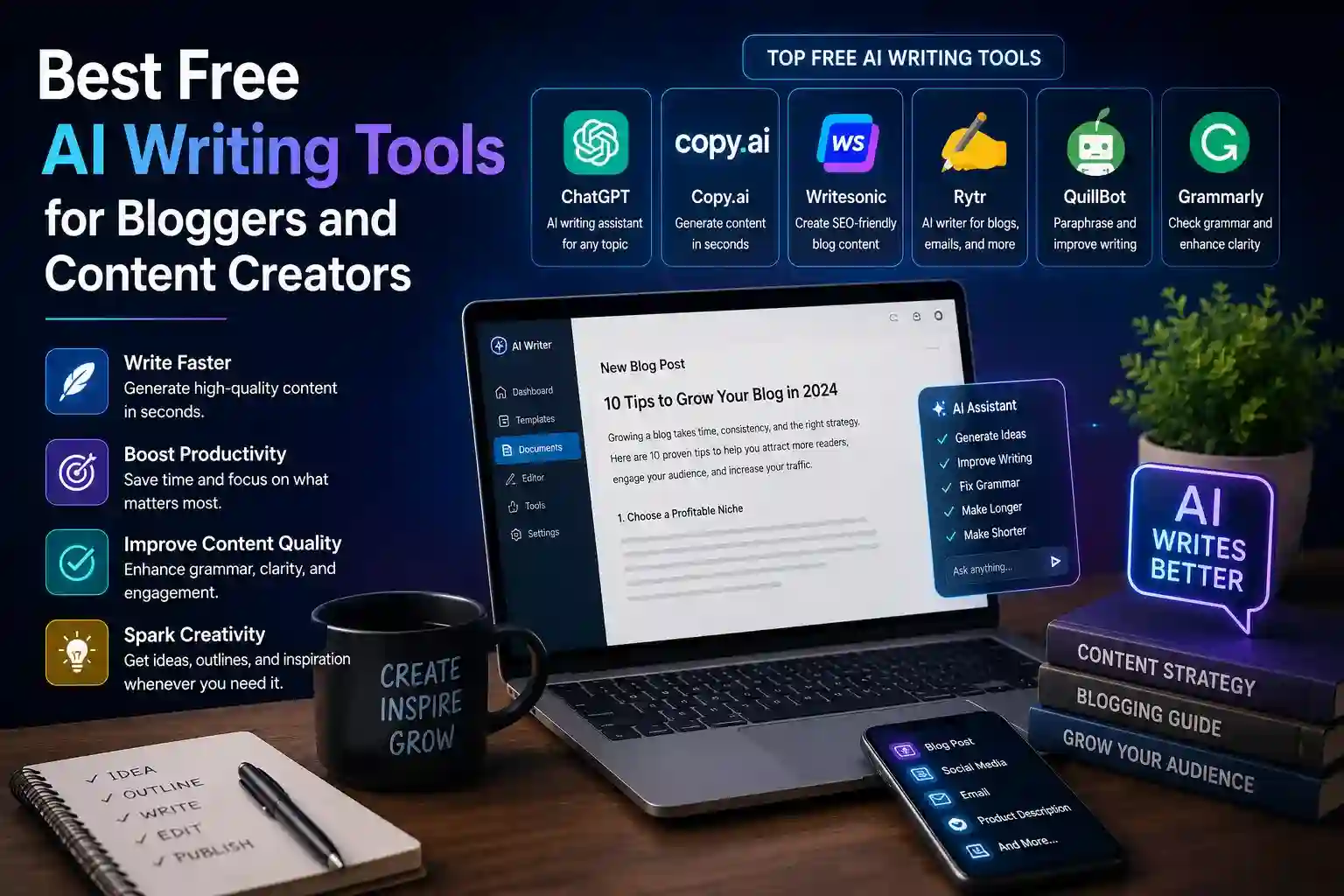
Content creation has always demanded time, consistency, and creative stamina. Free AI writing tools now absorb a meaningful portion of that burden — handling first drafts, restructuring weak paragraphs, generating headline variations, and flagging readability issues before a post goes live. For bloggers working without a team or budget, these tools have quietly become essential infrastructure.
The challenge isn’t finding AI writing tools — it’s knowing which free options actually deliver value versus those that frustrate with word limits, paywalled features, or output that still needs heavy rewriting.
What to Look for in a Free AI Writing Tool
Not every free tier is genuinely useful. Some tools offer enough capability to transform a workflow; others function as extended trials designed to push upgrades. Before committing time to any platform, it helps to evaluate against criteria that matter for real content work.
Characteristics that separate genuinely useful free AI writing tools from underwhelming ones:
- Output quality without heavy editing — the draft should be coherent, contextually accurate, and close to publishable without requiring complete rewrites
- Word or generation limits that accommodate real use — a 2,000-word monthly cap won’t support a blogger publishing twice a week
- Tone and style flexibility — the ability to shift between conversational, authoritative, or persuasive writing without switching tools
- Contextual awareness — tools that maintain consistency across a long article rather than drifting or contradicting earlier points
- SEO-aware output — naturally incorporating target keywords rather than stuffing them mechanically
- Accessibility without account friction — tools requiring extensive onboarding or credit card details for basic access create unnecessary barriers
- Editing and refinement capabilities — not just generation, but the ability to shorten, expand, or rephrase specific sections on demand
Any free tool that checks most of these boxes earns a place in a content creator’s workflow.
The Most Effective Free AI Tools by Use Case
Rather than ranking tools generically, understanding which tool excels at specific tasks produces better results. Different stages of content creation benefit from different capabilities.
- Drafting long-form content works best with conversational AI assistants that accept detailed prompts — specifying audience, tone, structure, and key points produces far more usable output than vague requests like “write a blog post about X.”
- Headline and title generation benefits from tools with A/B variation capability, producing ten or fifteen alternatives that can be evaluated against each other for clarity and search intent alignment.
- Introductions and hooks respond well to AI tools prompted with the specific emotion or problem the reader arrives with — frustration, curiosity, a practical need — producing openers that immediately address reader intent.
- Paragraph rewriting and clarity improvement suits grammar and style tools with AI suggestions layered on top of standard editing — these catch not just errors but structural weaknesses like passive voice overuse or unnecessarily complex sentence construction.
- Meta descriptions and social captions are where AI generates the most consistent value with least editing — short, format-constrained outputs with clear objectives suit AI generation exceptionally well.
- Outline creation remains one of the highest-leverage applications — a well-structured outline generated by AI takes minutes and prevents the structural problems that make long articles fall apart midway through.
- Repurposing existing content into different formats — a blog post into a newsletter, a how-to guide into a listicle — saves hours weekly for creators maintaining presence across multiple channels.
How to Get Better Results From Free AI Writing Tools
Free tiers have constraints. Getting maximum value means working intelligently within them rather than treating AI as a one-prompt solution.
Specificity in prompting is the single biggest lever. Vague instructions produce generic content. A prompt that specifies the reader’s problem, the desired tone, the approximate length, and the key point to communicate produces output that requires far less editing.
Treat AI output as a first draft, not a finished product. The most effective content creators use AI to eliminate blank-page paralysis and structural uncertainty, then layer their own voice, examples, and expertise on top. That combination — AI speed plus human depth — consistently outperforms either approach alone.
Batching AI tasks also stretches free-tier limits further. Generating all outlines for the month in a single session, then all introductions in another, makes better use of available generation credits than working article by article.
Finally, always fact-check AI-generated claims. Free tools don’t guarantee accuracy on specific statistics, dates, or technical details — treating their output as a structural scaffold rather than a factual authority protects credibility.
Conclusion
Free AI writing tools won’t replace the judgment, expertise, and original perspective that make content worth reading. What they reliably eliminate is the mechanical friction — the blank document, the weak introduction, the repetitive paragraph that needed cutting. Bloggers and content creators who integrate these tools strategically, using them for structure and speed while retaining ownership of voice and accuracy, consistently produce more content with less exhaustion. That efficiency compounds over time in ways that genuinely shift what’s possible as a solo creator.
Frequently Asked Questions
Q1: Are free AI writing tools good enough for professional blogging?
For drafting, outlining, and editing support, yes — many free tiers produce output quality sufficient for professional use. The limitation is usually volume: free plans restrict how much you can generate monthly, which requires strategic use rather than open-ended generation.
Q2: Will Google penalize content written with AI tools?
Google evaluates content quality, not its production method. AI-assisted content that is accurate, original, helpful, and clearly written for human readers performs well in search. Content that is thin, repetitive, or clearly generated without human editorial oversight tends to underperform regardless of how it was created.
Q3: What’s the best free AI tool for writing SEO-optimized blog posts?
The best choice depends on your workflow. General-purpose conversational AI tools handle long-form drafts well when given structured prompts. For keyword integration specifically, tools with built-in SEO scoring provide more direct guidance on optimization during the writing process.
Q4: How do I maintain my writing voice when using AI tools?
Start with an AI-generated draft, then rewrite key sections in your own voice — particularly the introduction, conclusion, and any sections where your personal experience or opinion is relevant. Reading the draft aloud also quickly reveals phrases that sound unnatural compared to how you typically write.
Q5: Can AI writing tools help with content repurposing?
Effectively, yes. Providing an existing article as context and asking the tool to reformat it as a social post, email newsletter, or video script saves significant time. The structure and key points translate well; you’ll still need to adjust length and tone for each platform.