

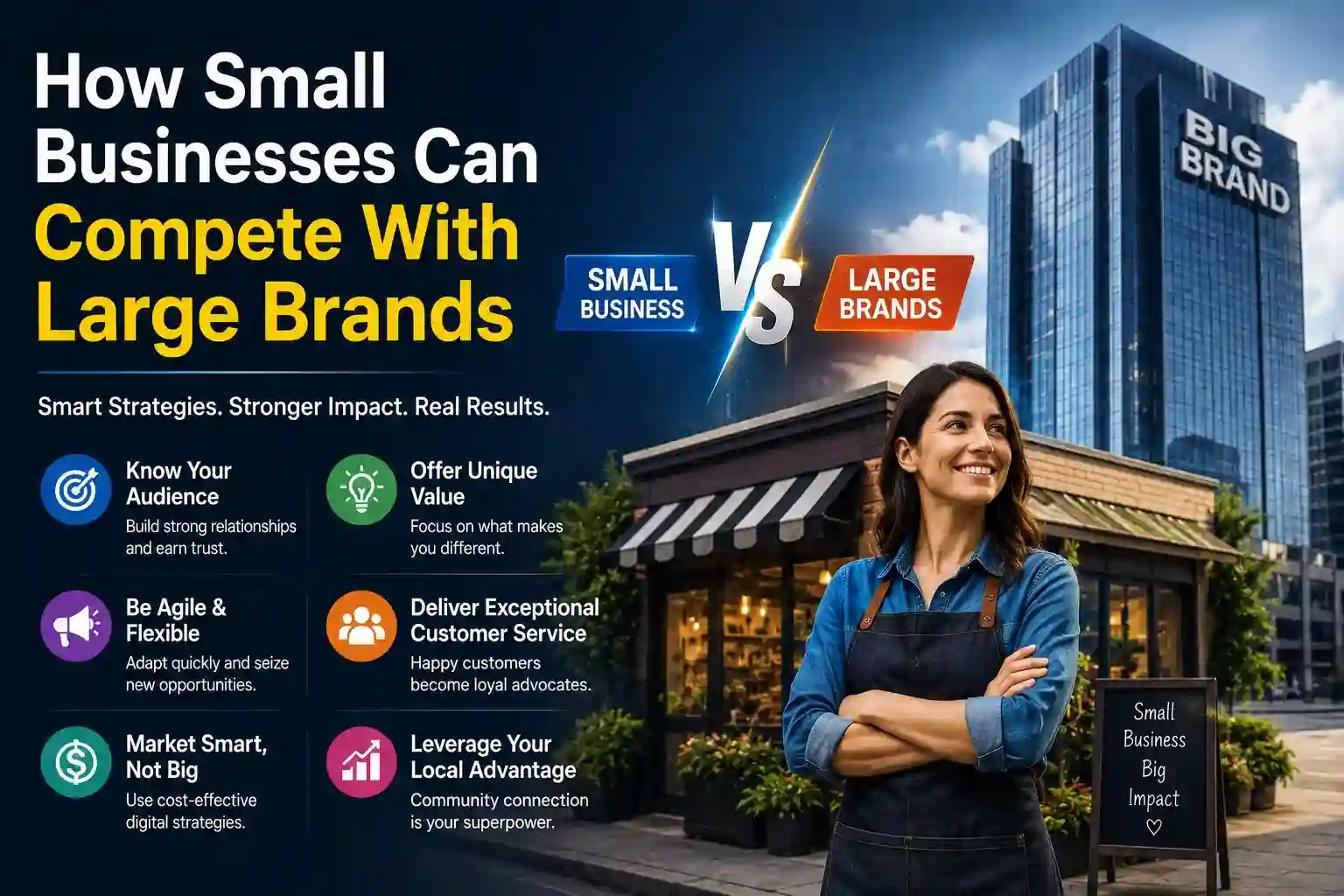
Large brands have bigger budgets, larger teams, and decades of brand recognition. But they also have something small businesses don’t — layers of bureaucracy, rigid processes, and a one-size-fits-all approach to customers.
That gap is exactly where small businesses win.
Competing doesn’t mean matching a corporation dollar for dollar. It means identifying where size becomes a disadvantage for them and turning that into a strategic edge for you.
Leverage Agility as a Competitive Weapon
Large companies take months to approve a campaign, change a product, or respond to market shifts. A small business owner can make that same decision before lunch.
This speed is a genuine competitive advantage — but only if it’s used deliberately.
- Respond to trends faster — When customer preferences shift or a local opportunity emerges, small businesses can pivot immediately without committee approval
- Personalize at the individual level — A large brand sends the same email to a million subscribers; a small business can tailor messaging to specific customer segments or even individuals
- Test and iterate quickly — New offers, pricing models, or marketing angles can be trialed and adjusted within days rather than quarters
- Build direct relationships — Owners who engage personally with customers create loyalty that no corporate loyalty program can manufacture
- Adapt products to feedback — Customer suggestions can be implemented rapidly, making buyers feel genuinely heard rather than processed
- Serve niche markets profitably — Large brands need mass-market volume; small businesses can dominate a specific segment that’s too small for corporations to prioritize
The businesses that treat agility as a core strategy — rather than a side benefit of being small — consistently outperform those that try to operate like scaled-down versions of big companies.
Build a Local and Community Presence That Corporations Can’t Fake
No matter how much a national chain spends on localization marketing, it cannot genuinely be part of a community the way a locally owned business can. This authenticity is both a differentiator and a marketing asset.
- Optimize for local SEO — Claiming and maintaining a complete business profile, gathering consistent reviews, and using location-specific keywords drives visibility that directly competes with larger brands in local search results
- Partner with complementary local businesses — Cross-promotions and referral arrangements with non-competing neighbors expand reach without advertising spend
- Sponsor community events — Local sponsorships generate goodwill and brand visibility at costs that deliver far higher returns than equivalent digital ad spend
- Create hyperlocal content — Blog posts, social content, and videos addressing local topics, events, or issues build search authority and community relevance simultaneously
- Engage on local social platforms and groups — Active participation in neighborhood forums and community groups keeps the business visible in organic, trusted contexts
- Highlight local ownership openly — Customers who prefer supporting independent businesses need to know they’re dealing with one; make it a visible part of the brand story
Community presence compounds over time. Each interaction, sponsorship, and local mention builds a reputation that takes years to develop — and is nearly impossible for a large brand to replicate authentically.
Use Digital Tools to Operate Like a Larger Business
The technology gap between small and large businesses has narrowed dramatically. Tools that once required enterprise budgets are now accessible at small business price points — and using them strategically closes the operational gap significantly.
Email marketing platforms allow small businesses to nurture customer relationships with the same sophistication as major retailers. AI-powered ad tools optimize campaigns automatically, making limited budgets compete effectively against larger spends.
A well-designed website with clear messaging and strong reviews often outperforms a corporate site in local and niche search results — because Google rewards relevance and authority, not company size.
Customer relationship management tools, even basic ones, enable follow-up sequences, purchase history tracking, and personalized outreach that make customers feel remembered and valued.
The goal isn’t to spend like a large brand. It’s to appear, communicate, and deliver at a standard that makes the size difference invisible to the customer.
Small Doesn’t Mean Lesser — It Means Different
The most effective small business owners stop framing competition as a resource battle and start framing it as a positioning challenge. Large brands compete on scale. Small businesses compete on depth — deeper relationships, faster responses, more specific solutions, and genuine community investment.
Customers who value those things will choose a small business every time. The job is making sure enough of them know you exist and understand what sets you apart.
Frequently Asked Questions
Q: Can a small business realistically compete with a national brand in the same market?
Yes — particularly in local markets and niche segments. Small businesses consistently outperform large brands on customer satisfaction, personalization, and community trust, which drive repeat business and referrals.
Q: What is the most cost-effective marketing strategy for a small business competing with bigger brands?
Local SEO combined with consistent review generation delivers the highest return for the lowest investment. It targets customers already searching for what you offer and positions you ahead of larger competitors in local results.
Q: How important is branding for a small business competing with large companies?
Extremely important. A clear, consistent brand identity signals professionalism and builds trust. Customers don’t need you to look like a Fortune 500 company — they need you to look credible and consistent.
Q: Should small businesses try to match the pricing of large brands?
Not necessarily. Competing on price alone is a losing strategy against companies with superior buying power. Competing on value, experience, and service justifies premium pricing and attracts customers who prioritize quality over cost.
Q: How can a small business build brand awareness without a large marketing budget?
Consistent content creation, active social media engagement, local partnerships, and word-of-mouth referral programs build awareness steadily without significant financial investment. Patience and consistency outperform sporadic large spending.