
Businesses operating in the United Arab Emirates must understand their tax responsibilities as their financial circumstances change. A company that stops trading, closes its operations, or experiences a reduction in taxable turnover may no longer need to remain registered for Value Added Tax (VAT), depending on the applicable conditions.
Knowing how to unregister for vat is important for businesses that want to maintain accurate tax records and meet Federal Tax Authority (FTA) requirements. VAT deregistration is a formal process that requires an application, supporting documents, and settlement of outstanding tax obligations.
Whether you are closing a company or no longer meeting the registration criteria, understanding the process can help you avoid unnecessary compliance issues.
What Does It Mean to Unregister for VAT in the UAE?
VAT deregistration is the official process of cancelling a business’s VAT registration with the Federal Tax Authority. Once the deregistration becomes effective, the business is no longer required to charge VAT on taxable supplies made after that date, unless it becomes liable to register again.
However, deregistration does not automatically cancel previous tax liabilities. Businesses must complete outstanding VAT returns, settle payable tax and administrative penalties, and fulfil their remaining obligations.
Companies should also understand that VAT deregistration and corporate tax deregistration are separate procedures.
Why Do Businesses Need to Unregister for VAT?
There are several circumstances in which a business may need or qualify to cancel its VAT registration.
1. Business Closure
If a company permanently stops making taxable supplies, it may be required to apply for VAT deregistration. Businesses closing their operations should also review their trade licence cancellation and liquidation documentation.
2. Reduced Business Turnover
A business whose taxable supplies fall below the voluntary registration threshold may become eligible or required to deregister, depending on its circumstances and future supply expectations.
3. Change in Business Activities
Some businesses change their operating models or move towards activities that are exempt or outside the scope of VAT. Their registration position should be reviewed according to the applicable VAT rules.
4. Company Restructuring
Business mergers, ownership changes, transfers, and restructuring may affect VAT registration arrangements. Companies should assess whether deregistration or another registration update is appropriate.
What Are the UAE VAT Deregistration Requirements?
Under UAE VAT legislation, businesses may face mandatory or voluntary deregistration conditions.
Mandatory VAT deregistration: A registered business must apply when it stops making taxable supplies and does not expect to make taxable supplies during the following 12 months. Deregistration may also be required when its taxable supplies over the previous 12 months fall below AED 187,500 and the relevant conditions for future supplies are satisfied.
Voluntary VAT deregistration: A business may apply when its taxable supplies over the previous 12 months are below the mandatory registration threshold of AED 375,000, subject to applicable legal conditions.
A business that registered voluntarily generally cannot apply for deregistration within the first 12 months of its VAT registration.
The applicable conditions should be assessed carefully before submitting an application because falling below a particular turnover figure does not automatically mean that every business must deregister.
Which Documents Are Required to Unregister for VAT?
The Federal Tax Authority may request documents to confirm the reason for deregistration and verify the business’s financial position.
Common documents include:
- Valid trade licence and licence cancellation certificate, where applicable.
- Company liquidation documents or relevant board resolution.
- Financial turnover information showing taxable income and expenses.
- Supporting sales and purchase records.
- Business closure or cessation declaration.
- Updated company information and authorised signatory details.
- Supporting documents explaining changes in business activities.
Additional documentation may be necessary depending on whether the business is closing, selling its licence, reducing its taxable supplies, or changing its legal structure.
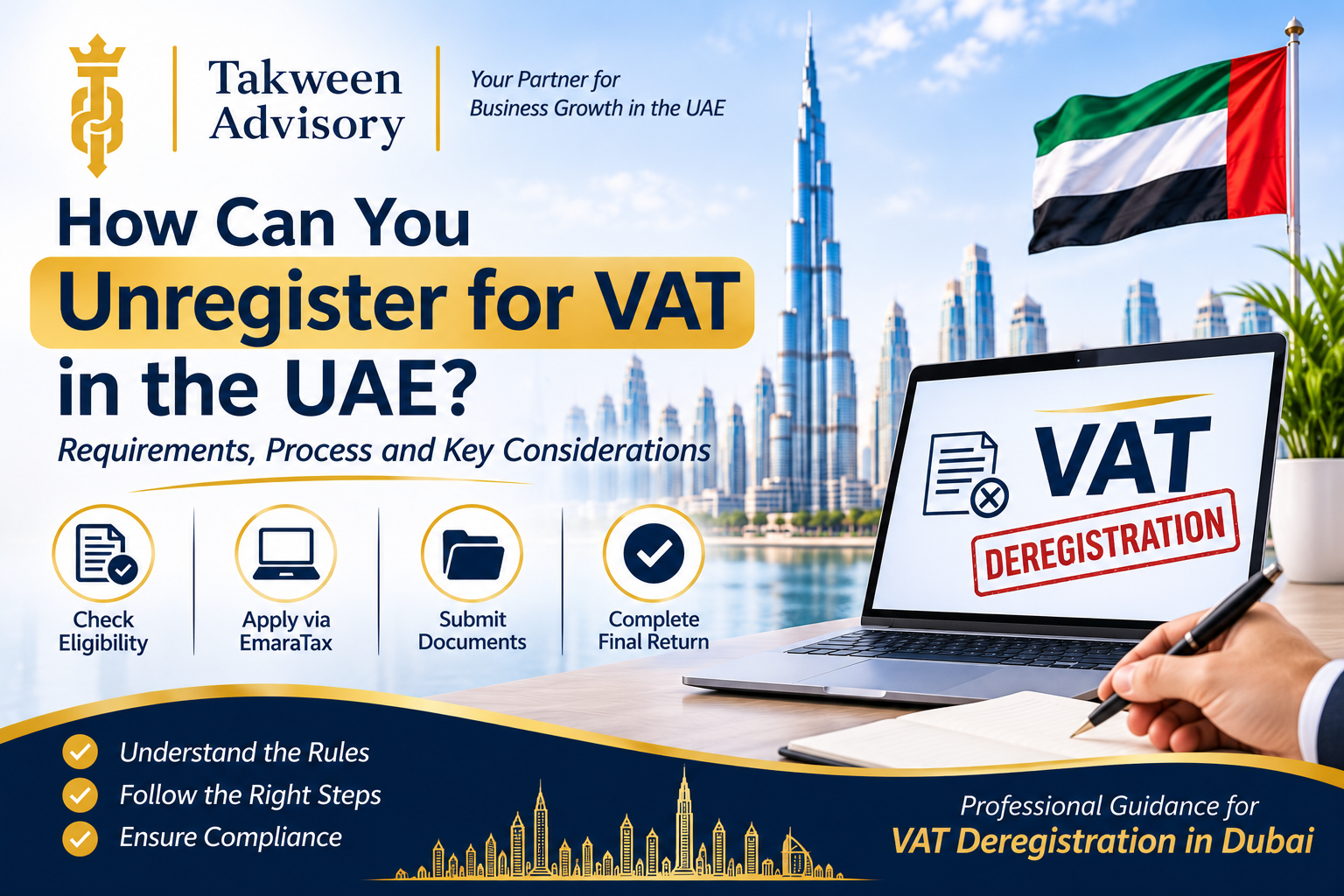
How Can You Unregister for VAT Through EmaraTax?
Businesses can submit their VAT deregistration applications through the FTA’s EmaraTax digital platform.
Follow these general steps:
Step 1: Log In to EmaraTax
Access your existing EmaraTax account using the registered login credentials.
Step 2: Open Your Taxable Person Account
Select the relevant taxable person profile associated with your business and VAT registration.
Step 3: Select VAT Deregistration
Under the VAT section, choose the Actions option and select De-Register.
Step 4: Select the Deregistration Reason
Provide the reason for cancelling your VAT registration, such as business closure, reduced taxable supplies, or another applicable circumstance.
Step 5: Upload Supporting Documents
Attach the required financial information, declarations, licence documents, and other supporting evidence.
Step 6: Review and Submit
Check the information carefully before submitting the application. Monitor your EmaraTax dashboard for updates or additional document requests.
The FTA currently lists the VAT deregistration service as free of charge and estimates approximately 30 business days to process a completed application.
What Happens After VAT Deregistration?
Submitting an application does not immediately complete the deregistration process. Businesses must fulfil the remaining requirements.
Important responsibilities include:
- Submit the final VAT return.
- Pay outstanding VAT liabilities.
- Settle applicable administrative penalties.
- Account for VAT on relevant business assets where required by law.
- Retain VAT records for the applicable statutory period.
- Obtain the VAT deregistration certificate after approval.
The final VAT return and any payable tax are generally due within 28 days from the effective deregistration date. Businesses should also remember that deregistration does not remove liabilities arising from earlier tax periods.
For mandatory deregistration cases, Article 14 of the VAT Executive Regulation specifies a 20-business-day application deadline. Businesses should act promptly and follow the applicable legal deadline rather than delay their application.
How Can Takween Advisory Help Businesses Unregister for VAT?
Understanding eligibility conditions, preparing financial records, and completing the EmaraTax application can be challenging for business owners.
Takween Advisory provides professional guidance to businesses seeking assistance with VAT deregistration in Dubai and across the UAE. Its team can help clients understand applicable requirements, organise supporting documents, review financial information, and navigate the deregistration process.
Whether a company is closing its operations or reviewing its VAT registration status due to reduced turnover, professional guidance can help business owners approach the process in an organised manner.
Frequently Asked Questions
1. How can I unregister for VAT in the UAE?
You can apply through the FTA’s EmaraTax platform by accessing your taxable person account, selecting VAT deregistration, providing the reason, and uploading supporting documents.
2. What is the VAT deregistration threshold in the UAE?
A business may qualify for voluntary deregistration when its taxable supplies over the previous 12 months are below AED 375,000, subject to applicable conditions. The voluntary registration threshold is AED 187,500.
3. Is VAT deregistration mandatory when a business closes?
A business that stops making taxable supplies and does not expect to make them during the following 12 months is generally required to apply for deregistration.
4. How long does VAT deregistration take?
The FTA currently estimates approximately 30 business days to process a completed application. Additional document requests may extend the process.
5. Is there a fee for VAT deregistration?
The FTA currently provides its VAT deregistration application service free of charge. Professional advisory services may involve separate fees.
6. Do I need to file a final VAT return after deregistration?
Yes. Businesses must submit their final VAT return and settle outstanding tax liabilities and applicable penalties within the prescribed period.
7. Can Takween Advisory help me unregister for VAT?
Yes. Takween Advisory can provide guidance on eligibility, supporting documents, EmaraTax procedures, and relevant UAE VAT deregistration requirements.
Conclusion
Understanding how to unregister for VAT is essential for UAE businesses that have stopped taxable activities, experienced reduced turnover, or undergone operational changes. From checking eligibility and preparing documents to submitting the application and completing the final VAT return, every stage requires careful attention.
Businesses should review their circumstances and follow the applicable FTA requirements to avoid unnecessary compliance complications. With professional guidance from Takween Advisory, companies can better understand their VAT deregistration responsibilities and manage the process with confidence.