
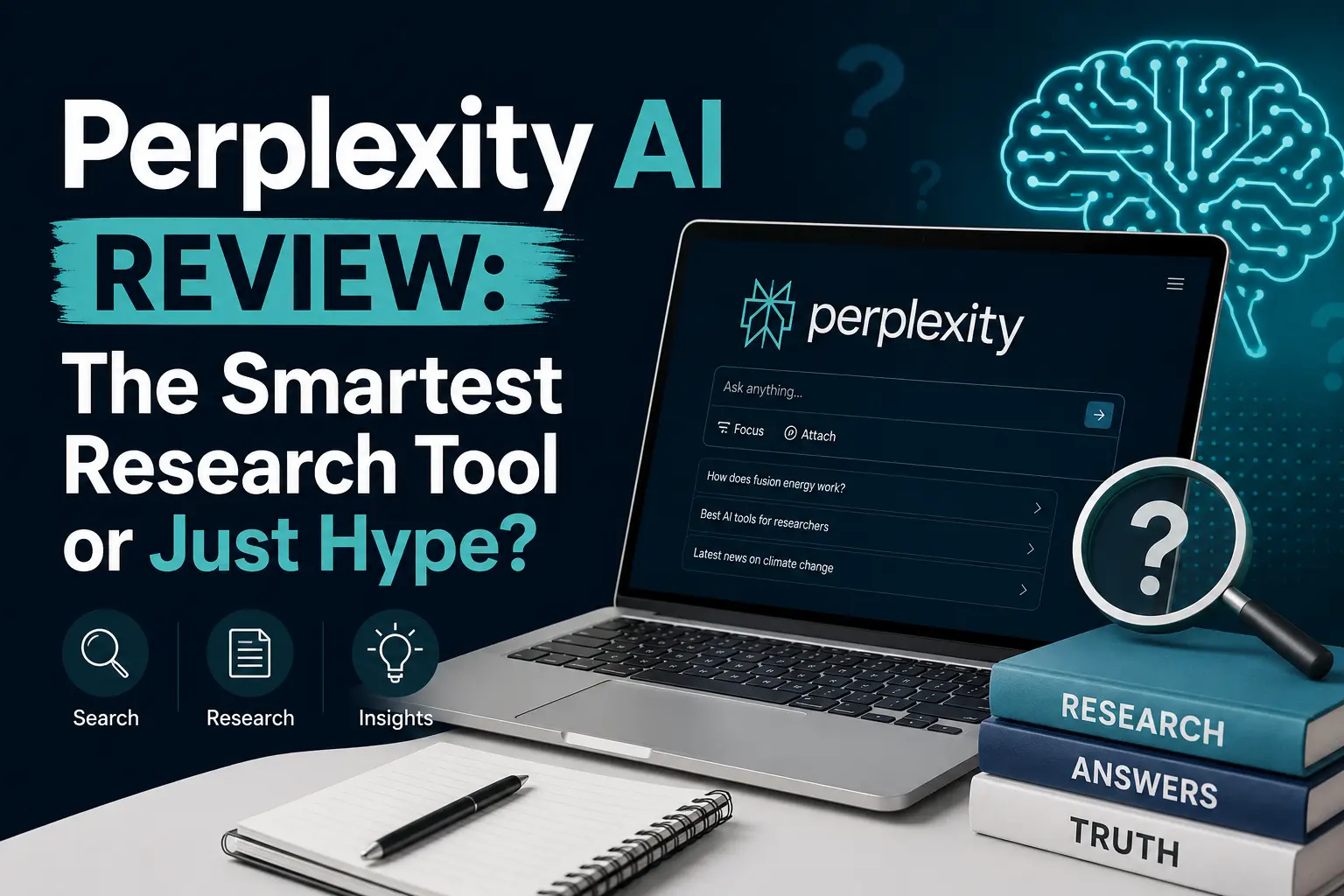
Traditional search engines increasingly struggle with cluttered ad layouts and superficial content optimization, turning basic web discovery into a time-consuming chore. Conventional artificial intelligence chatbots present a different problem: they confidently deliver out-of-date answers or fabricate realistic-looking misinformation. Perplexity AI claims to bypass both hurdles by combining real-time web indexation with leading LLM reasoning engines.
Positioning itself as an “answer engine” rather than a standard conversational interface, the software aims to revolutionize how professionals investigate layered, complex topics. This review breaks down Perplexity’s core operational framework, premium features, and performance limitations to evaluate if it truly justifies replacing your current search tools.
Core Pillars of the Answer Engine Ecosystem
The platform distinguishes itself from standard language models by putting source verification directly into its generation loop, ensuring every output links back to open web data.
-
Up-to-Front Citations: Integrates hyperlinked footnotes into every line of generated text, allowing users to instantly track claims back to their source websites.
-
Autonomous Deep Research Agents: Orchestrates multi-step web navigation loops that run deep search queries, evaluate parallel source angles, and compile comprehensive structural briefs automatically.
-
Dynamic Model Flexibility: The premium interface functions as an aggregator, allowing users to toggle their underlying reasoning core between GPT-5.4, Claude Sonnet 4.6, Gemini 3.1 Pro, or proprietary Sonar models.
-
Dedicated Focus Mode Controls: Features targeted workspace filters, allowing you to narrow searches strictly down to Academic papers, Financial disclosures, or public code documentation.
-
Internal Knowledge Infrastructure: Permits drag-and-drop ingestion of large local data assets, including messy spreadsheets or hundred-page PDF manuals, cross-referencing them against active live web data.
Practical Strengths in Professional Workflows
Shifting your investigative routines to a real-time synthesis engine introduces major advantages for analytical and academic productivity.
-
Drastically Shorter Fact-Finding Cycles: Gathering context on shifting topics—such as analyzing a competitor’s pricing update from last week—takes minutes instead of a half-hour of manual link-clicking.
-
Objective, Ad-Free Answers: The platform uses a clean, subscription-first setup that does not prioritize sponsored links, keeping text outputs unbiased and focused on factual information.
-
Iterative Thinking Guidance: Every completed answer automatically suggests logical follow-up questions, functioning as a real-time sounding board that reveals angles you might have missed.
-
Instant Knowledge Packaging: Through integrated compilation features, users can instantly convert a long, exploratory research thread into a clean, shareable document or professional brief.
System Flaws and Blind Spots
Despite its efficiency, treating an AI-driven search compiler as a flawless authority introduces unique workflow risks that require careful human oversight.
The system’s greatest asset—its citation framework—can sometimes create a false sense of security. Perplexity can occasionally misinterpret text on a page, attributing quotes or specific metrics to a linked source that doesn’t actually contain that information. It caches web pages quickly, meaning it can miss contextual shifts if an underlying source article is updated.
Furthermore, the platform is strictly optimized for information retrieval and synthesis. It struggles with tasks requiring deep creative narrative writing, brand-voice consistency, or extensive production coding, which are better left to dedicated standalone model workspaces. Data tracking rules also require care: users must manually opt out of history training models to safeguard proprietary corporate data from being analyzed by future algorithms.
Conclusion
Perplexity AI successfully escapes the hype cycle by offering a genuinely transformative tool for information gathering, competitive analysis, and document synthesis. Its multi-model access and real-time source mapping provide immediate value that traditional search engines cannot match. While users must still double-check crucial citations for accuracy, the platform serves as an essential productivity catalyst for analysts, researchers, and knowledge workers.
FAQs
How does Perplexity differ from a tool like ChatGPT?
ChatGPT operates primarily as a generative creation engine relying on internal model weights, whereas Perplexity is a specialized web answer engine optimized to crawl the live internet and summarize real-time sources with direct citations.
Can I trust the citations provided in the summaries?
Most citations are highly accurate, but the algorithm occasionally misattributes data or draws from outdated web caches. Always click the footnote to verify critical figures before placing them in formal reports.
What advanced models are available on the Pro tier?
The Pro tier unlocks the “Model Council” workspace, letting you route questions through cutting-edge frontier systems including OpenAI’s GPT-5 series, Anthropic’s Claude 4.6 family, and Google’s Gemini Pro.
Can the system search through password-protected files or paywalled sites?
No, the engine can only access public data indexed on the open web. It cannot bypass digital paywalls, private database protections, or secure academic logins on its own.
Is my uploaded document data kept confidential?
Standard security options allow you to turn off conversation history logging, preventing your private PDFs, financial sheets, and prompt inputs from being used for public system training.