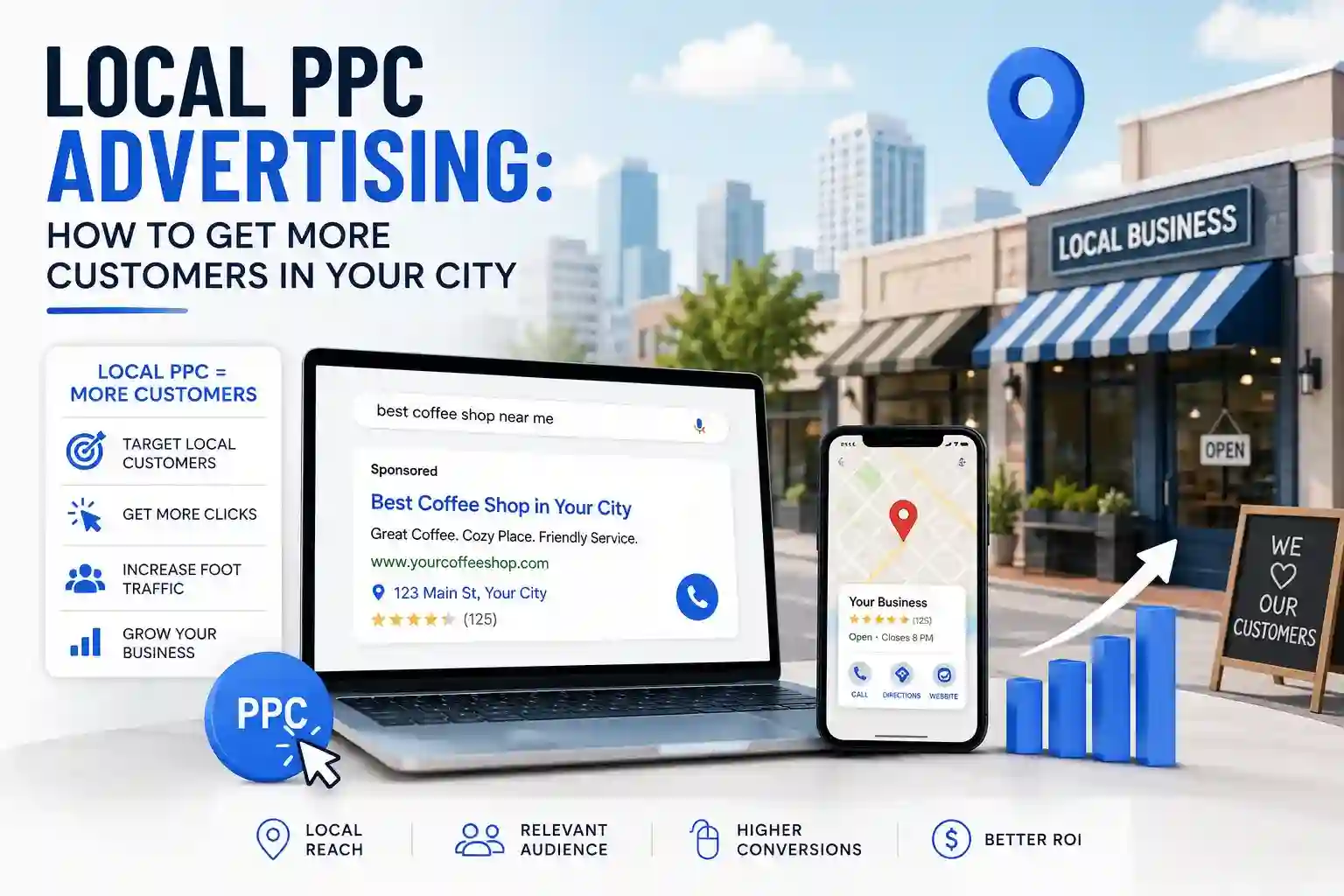

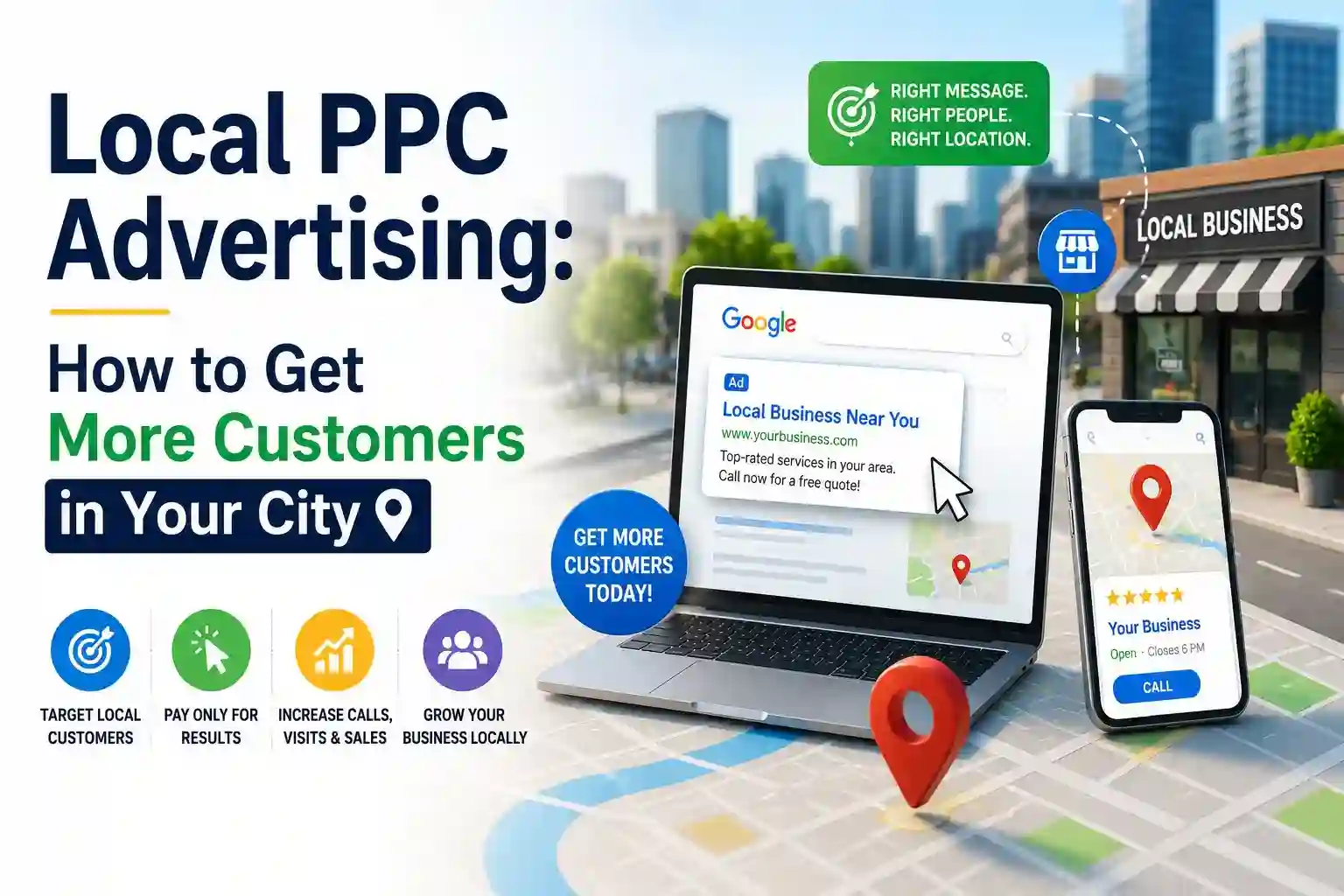
A plumber in Chicago doesn’t need website visitors from Miami. A family dentist in Austin gains nothing from clicks originating in Seattle. Local PPC advertising exists precisely to solve this problem — putting paid search ads in front of people who are physically close enough to become actual customers.
When configured correctly, local pay-per-click campaigns deliver some of the highest returns available in digital advertising. The intent is high, the geography is controlled, and the path from search to conversion is short. When configured poorly, they drain budgets on irrelevant clicks without producing a single phone call or store visit.
The difference between those two outcomes comes down to how the campaign is built.
The Building Blocks of an Effective Local PPC Campaign
Most local businesses that struggle with PPC aren’t using the wrong platform — they’re using the right platform incorrectly. The foundational elements of a high-performing local campaign require deliberate configuration, not default settings.
What every effective local PPC campaign must get right:
- Geo-targeting precision set to the specific radius, city, or postcode where your customers actually live — not the broader default region the platform suggests, which routinely wastes budget on searchers who will never drive to your location
- Location-based keyword structure incorporating city names, neighborhood references, and proximity phrases like “near me” that signal genuine local intent rather than general research behavior
- Ad scheduling aligned with business hours so budget concentrates during periods when calls can be answered and appointments can be booked — running ads at 2am for a business that opens at 9am generates clicks that convert to nothing
- Call extensions and location extensions attached to every ad, giving mobile users a direct dial option and showing the physical address to reinforce local relevance before the click even happens
- Negative keyword lists filtering out searches that attract the wrong traffic — competitor brand names, job-seeking phrases, DIY-intent queries, and geographic terms outside your service area
- Dedicated local landing pages matching each ad’s specific city or neighborhood reference, so visitors who click on “emergency electrician North Dallas” land on a page that confirms exactly that service in exactly that area
- Conversion tracking connected to phone calls not just form submissions, since most local service businesses convert primarily through inbound calls rather than online contact forms
Neglecting any one of these elements creates a leak in the campaign — ad spend flowing out without proportional customer acquisition flowing in.
Campaign Types That Work Best for Local Customer Acquisition
Not all PPC campaign types serve local customer acquisition equally. Choosing the right format for each objective prevents budget dilution across placements that look impressive in reports but don’t generate revenue.
- Google Search campaigns targeting high-intent local queries — “best Italian restaurant downtown,” “HVAC repair same day,” “personal injury lawyer free consultation” — capture searchers actively seeking what you offer at the moment they’re ready to act.
- Google Local Services Ads display above traditional search results for service businesses, showing a verified badge, star rating, and direct call option — paying per verified lead rather than per click, which reduces wasted spend on non-converting traffic.
- Performance Max campaigns with local signals use customer data and location inputs to find conversion-ready audiences across Google’s full network, effective for businesses with enough conversion history for the algorithm to optimize against.
- Remarketing campaigns targeting past website visitors within your geographic area keep your business visible to local prospects who researched but didn’t convert initially — a second touchpoint that frequently closes sales the first visit didn’t.
- Display campaigns on local news and community sites build brand familiarity among city residents who aren’t actively searching yet, warming audiences that search campaigns will later convert — particularly valuable for higher-consideration purchases with longer decision cycles.
- Microsoft Advertising local campaigns reach a distinct audience segment through Bing search, often at lower cost-per-click than Google due to reduced competition, with comparable local targeting capabilities worth leveraging alongside Google campaigns.
Optimizing Local PPC Campaigns for Sustained Performance
Launching a local PPC campaign is straightforward. Maintaining its performance over weeks and months requires consistent attention to data signals that reveal what’s working and what’s draining budget invisibly.
Search term reports deserve weekly review. The actual queries triggering your ads frequently reveal irrelevant traffic patterns that negative keywords haven’t yet filtered. Each irrelevant term added to the negative keyword list immediately improves campaign efficiency without reducing reach among genuine local prospects.
Bid adjustments by device matter significantly for local campaigns. Mobile searches dominate local intent — “open now,” “near me,” “directions to” — making higher mobile bids appropriate for most local service businesses. Desktop bids can often be reduced without meaningful impact on conversion volume.
Geographic performance data reveals which specific areas within your target zone generate conversions versus which areas generate clicks that don’t convert. Reducing bids in low-converting zones while increasing them in high-converting neighborhoods concentrates budget where customers actually come from rather than spreading it uniformly across the entire city.
Quality Score improvement reduces cost per click without reducing ad position. Writing ad copy that directly mirrors the search query, connecting it to a landing page that reinforces the same message, consistently improves Quality Scores — lowering what you pay for every click the campaign generates.
Conclusion
Local PPC advertising rewards precision. The businesses generating the strongest return aren’t necessarily spending the most — they’re targeting the most accurately, matching ad messages to landing pages consistently, and eliminating wasted spend through disciplined negative keyword management and bid optimization. A campaign built on these principles turns local search intent into booked appointments, inbound calls, and in-store visits at a predictable, scalable cost. That’s the tangible outcome local PPC makes possible when it’s approached as a system rather than a set-and-forget expense.
Frequently Asked Questions
Q1: What is the minimum budget needed to run effective local PPC advertising?
Effective local campaigns can start at $500 to $1,000 per month in many markets, though competitive industries like legal services, home renovation, or medical care require higher budgets to achieve meaningful visibility. The right starting budget depends on local competition levels and the average cost-per-click for your target keywords — research these before committing spend.
Q2: How is local PPC different from local SEO?
Local PPC places paid ads at the top of search results immediately, generating traffic from the day a campaign launches. Local SEO builds organic ranking over months through content, citations, and backlinks. Both are valuable — PPC provides speed and control; SEO provides compounding long-term returns. Most successful local businesses run both simultaneously.
Q3: Should local businesses use broad match or exact match keywords in PPC campaigns?
For local campaigns with limited budgets, exact match and phrase match keywords provide significantly more control over which searches trigger ads. Broad match can work effectively once a campaign has conversion data for the algorithm to optimize against — but deploying it too early typically wastes budget on irrelevant traffic before performance patterns are established.
Q4: How do I track whether my local PPC ads are actually generating customers?
Connect call tracking numbers to your ads so inbound calls are attributed to specific campaigns and keywords. Set up conversion tracking for form submissions and appointment bookings. For physical locations, enable store visit conversions in Google Ads. Reviewing these metrics weekly reveals which campaigns, keywords, and ad variations are genuinely driving customer acquisition versus which are generating clicks without outcomes.
Q5: How long does it take for a local PPC campaign to start delivering results?
Basic traffic begins immediately after launch. Meaningful optimization — enough conversion data to identify what’s working and refine bidding, targeting, and ad copy — typically takes four to eight weeks. Campaigns generally reach their most efficient performance between months two and four, once negative keyword lists are refined and Quality Scores have improved through iterative testing.