

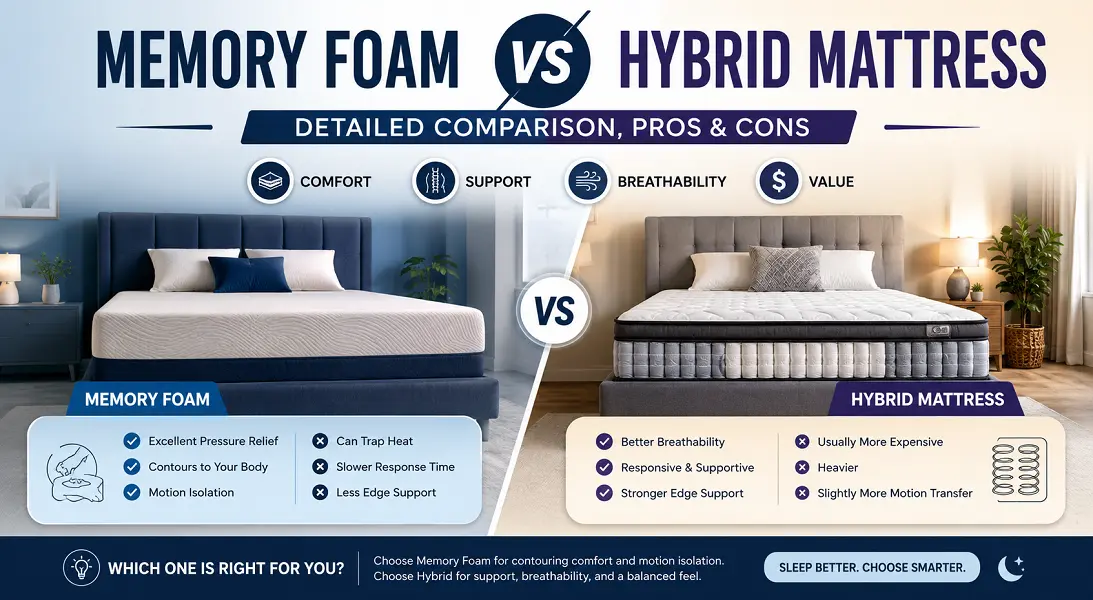
If you’ve been lying awake at 1 AM scrolling through mattress websites, you already know the problem: every brand claims theirs is the “best sleep of your life.” So let’s skip the marketing talk and get to what actually matters.
Quick answer: Memory foam mattresses hug your body and isolate motion really well, which makes them great for side sleepers and light sleepers who share a bed. Hybrid mattresses combine foam layers with an innerspring coil system, giving you more bounce, better airflow, and stronger edge support — better suited for back and stomach sleepers, or anyone who runs hot at night.
That’s the one-line version. Now let’s break down why.
Memory Foam vs Hybrid Mattress: Quick Comparison Table
| Feature | Memory Foam | Hybrid |
|---|---|---|
| Support Type | Dense foam layers, body-contouring | Coils + foam comfort layers |
| Motion Isolation | Excellent — barely feel your partner move | Moderate — some bounce transfers |
| Cooling | Tends to trap heat unless gel-infused | Better airflow through the coil layer |
| Firmness Range | Soft to medium-firm | Medium to firm |
| Edge Support | Weak, can feel like it’s sinking | Stronger, coils hold the perimeter |
| Durability | Usually 8–10 years | Usually 7–10 years |
| Price | Generally more affordable | Usually costs more due to coil construction |
| Best For | Side sleepers, joint pain, couples who move a lot | Back/stomach sleepers, hot sleepers, combo sleepers |
That’s the chart version most people are actually searching for. But a table alone won’t tell you which one you should buy — for that you need to understand how each one behaves once you’re actually lying on it.
What Is a Memory Foam Mattress, Really?
Memory foam was originally developed by NASA for aircraft seat cushioning, believe it or not. It reacts to body heat and pressure, softening exactly where you need it and staying firmer where you don’t. That’s why it feels like it’s “hugging” you.
The upside:
- Deep pressure relief — great if you deal with shoulder or hip pain
- Almost zero motion transfer, so a restless partner won’t wake you up
- Quiet — no springs, no creaking
The downside:
- Heat retention is a real issue, especially with older, denser foams
- It can feel like you’re sinking rather than lying “on” the bed
- Getting out of bed (or having sex, honestly) can feel harder because there’s less bounce
I’ve had a memory foam mattress for close to four years now, and the heat thing is not exaggerated — even the “cooling gel” version I bought still runs warmer than any spring mattress I’ve slept on. If you sleep in a hot climate or you’re someone who just runs warm naturally, that’s worth factoring in before you buy.
What Is a Hybrid Mattress?
A hybrid mattress is basically the best-of-both-worlds pitch — pocketed coils for support and bounce, topped with a few inches of memory foam or latex for comfort. You get some of the pressure relief of foam without losing the responsiveness of a traditional spring bed.
The upside:
- Coils allow air to circulate, so it sleeps noticeably cooler
- Better edge support, so the mattress doesn’t feel smaller than it is
- More “give” and bounce, which some people just prefer
The downside:
- Heavier and harder to move (trust me, moving a hybrid queen up a staircase is a two-person job minimum)
- Motion transfer is more noticeable than pure foam
- Usually pricier for a comparable quality tier
The Differences That Actually Matter (Not Just Marketing Buzzwords)
Support and Pressure Relief
Memory foam wins here for side sleepers because it cradles your shoulders and hips. Hybrid mattresses distribute weight more evenly across the coil system, which back and stomach sleepers tend to prefer since they need a flatter, more even surface.
Temperature Regulation
This one’s not close. Coils create airflow channels that foam simply can’t replicate on its own. If night sweats are already a problem for you, a hybrid is the safer bet — no contest.
Motion Isolation
If you share a bed with a partner, a pet that jumps up at 3 AM, or a toddler who climbs in uninvited, memory foam absorbs that movement far better. Hybrids transmit more bounce through the coil layer.
Price and Longevity
Memory foam mattresses are generally cheaper to manufacture, so entry-level options are more budget-friendly. Hybrids cost more upfront because of the coil system, but a good one can last just as long — sometimes longer, depending on coil gauge and foam density.
So, Which One Should You Actually Buy?
Here’s a rough guide based on sleep position and common concerns:
- Side sleeper with joint pain → Memory foam
- Back or stomach sleeper → Hybrid
- Hot sleeper / live somewhere warm → Hybrid
- Light sleeper sharing a bed → Memory foam
- Want a bed that feels more like a traditional mattress → Hybrid
- On a tighter budget → Memory foam (generally)
None of this is a hard rule, though. I know plenty of stomach sleepers who swear by soft memory foam, and side sleepers who prefer a hybrid with a thick pillow top. Body weight, mattress firmness rating, and even the sheets you use all play a role too.
A Few Mistakes People Make While Choosing
- Buying based on a showroom test lie-down. Five minutes in a store tells you almost nothing — you need at least a few nights to know how a mattress actually performs.
- Ignoring the trial period. Most reputable brands now offer 90–100 night trials. Use that window fully before deciding it’s “the one.”
- Not checking firmness in numbers. “Medium” means different things to different brands. Look for the actual firmness rating (usually on a 1–10 scale) instead of trusting the label alone.
- Assuming price equals quality. Some mid-range hybrids outperform overpriced “luxury” memory foam options — read verified buyer reviews, not just influencer posts.
Final Thoughts
There’s no universal winner in the memory foam vs hybrid mattress debate — it genuinely comes down to how you sleep, what temperature you run at night, and what your budget looks like. If you want that sink-in, hug-you feeling and you don’t overheat easily, memory foam is hard to beat for the price. If you toss and turn, sleep hot, or just like a bed with a bit more bounce, a hybrid is probably going to serve you better long-term.
Whichever you pick, don’t rush it. A mattress is one of the few purchases you’ll spend roughly a third of your life on — it’s worth the extra week of research.
Frequently Asked Questions
1. Is a hybrid mattress better than memory foam?
Not universally — it depends on your sleep position and temperature preference. Hybrids sleep cooler and offer more bounce; memory foam offers deeper pressure relief and better motion isolation.
2. Which mattress type lasts longer, memory foam or hybrid?
Both typically last 7–10 years with proper care. High-density memory foam and high-coil-count hybrids tend to last on the longer end of that range.
3. Do hybrid mattresses sleep cooler than memory foam?
Yes, generally. The coil layer allows airflow that solid foam layers can’t replicate, so hybrids usually sleep noticeably cooler.
4. Is memory foam bad for back pain?
Not necessarily — medium-firm memory foam can actually help by cradling pressure points. Very soft memory foam, though, can lead to poor spinal alignment for back sleepers.
5. Which is more expensive, memory foam or hybrid?
Hybrids are usually pricier because of the coil system and construction cost, though budget options exist in both categories.
6. Can couples with different sleep preferences use a hybrid mattress?
Yes — many hybrids come in dual-firmness options, and the added bounce works well for couples who like more responsiveness.
7. Do memory foam mattresses smell when new?
Some off-gassing smell is common in the first few days as the foam expands and settles. It’s generally harmless and fades within a week with proper ventilation.
8. Is a hybrid mattress good for stomach sleepers?
Yes, hybrids tend to offer more even, flatter support, which helps keep the spine aligned for stomach sleepers.
9. How do I know if a mattress is too firm or too soft?
If you wake up with lower back pain, it may be too soft. If you feel pressure points on your shoulders or hips, it’s likely too firm.
10. Are hybrid mattresses good for heavier body types?
Often, yes — the coil support system generally handles higher weights better than all-foam construction, preventing excessive sinkage.
11. Do memory foam mattresses need a special base?
Most work fine on a solid platform, slatted base, or adjustable frame — just check the manufacturer’s warranty requirements first, since some void the warranty on unsupported slats.
12. How long is the average trial period for these mattresses?
Most brands offer 90 to 365 nights, though 100 nights is the most common standard in the industry.
13. Which is quieter, memory foam or hybrid?
Memory foam is quieter since there are no coils to creak or squeak over time.
14. Do hybrid mattresses require a box spring?
No — most modern hybrids are designed for platform beds or adjustable bases and don’t need a traditional box spring.
15. Is it worth paying more for a hybrid mattress?
If cooling, edge support, or a more traditional bounce feel matters to you, yes. If budget and motion isolation matter more, memory foam usually delivers better value.