
Running a small business means making every dollar and every hour count. Hiring more staff to handle growth isn’t always financially viable. Expanding marketing budgets without guaranteed returns feels risky. AI tools have shifted this equation — giving small business owners access to capabilities that previously required enterprise-level resources, at a fraction of the cost.
The practical question isn’t whether AI can help small businesses. It’s which applications deliver real, measurable returns without demanding technical expertise or significant upfront investment.
AI Applications That Directly Drive More Revenue
Sales growth for small businesses rarely comes from a single breakthrough — it accumulates through better customer targeting, faster follow-up, and fewer missed opportunities. AI addresses each of these pressure points systematically.
Where AI produces the clearest revenue impact for small businesses:
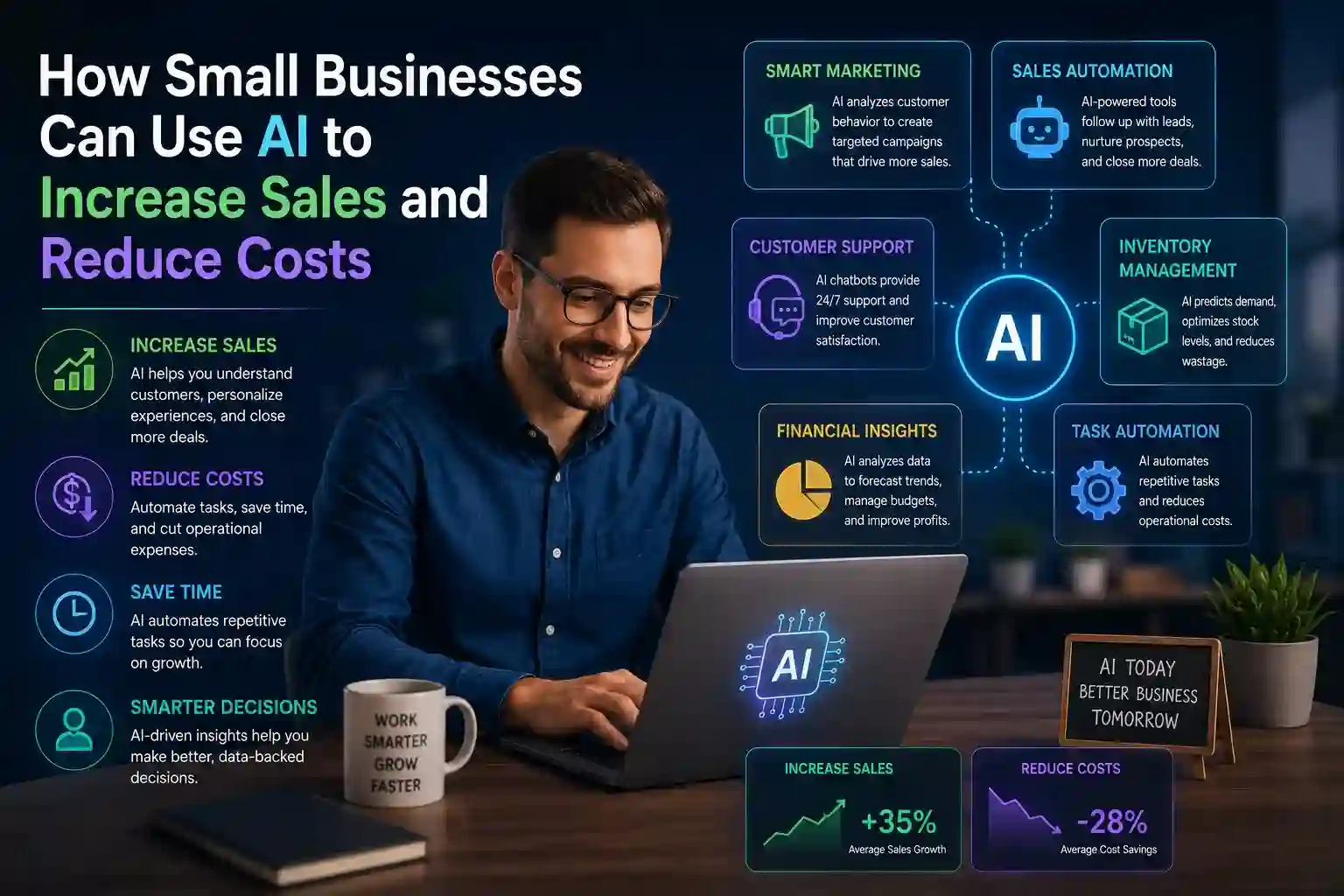
- Personalized product recommendations analyze purchase history and browsing behavior to surface relevant items at the right moment, increasing average order value without additional advertising spend
- AI-powered email marketing segments customer lists automatically and tailors message content based on individual behavior — open rates and conversions improve because recipients receive offers that match their demonstrated interests
- Chatbot-driven lead capture engages website visitors around the clock, answering questions, qualifying prospects, and booking appointments even when staff are unavailable — leads that previously bounced now enter the sales funnel
- Predictive sales analytics identify which customers are most likely to purchase again, which are at risk of churning, and which product lines have untapped demand — allowing owners to direct attention where it generates the highest return
- Dynamic pricing tools adjust prices based on demand signals, competitor activity, and inventory levels, maximizing margin during high-demand periods without manual monitoring
- Social media content scheduling and optimization uses AI to determine the best posting times, suggest engaging captions, and track which content formats drive the most traffic — compounding organic reach without hiring a social media manager
Each of these applications operates largely autonomously once configured, meaning revenue benefits accumulate without proportional increases in staff time.
Where AI Cuts Costs Without Cutting Quality
Cost reduction through AI works differently than traditional expense cutting. Rather than eliminating capabilities, it automates the delivery of existing capabilities — maintaining or improving output while reducing the human hours required.
The most impactful cost-reduction opportunities for small businesses:
- Customer service automation handles common inquiries — order status, store hours, return policies, appointment scheduling — through AI chatbots, reducing the volume of calls and emails staff must personally address without degrading the customer experience.
- AI bookkeeping and expense categorization automatically sorts transactions, flags anomalies, and prepares financial summaries, cutting the time owners or accountants spend on routine data entry by a significant margin.
- Inventory management optimization uses demand forecasting to prevent both overstocking and stockouts — excess inventory ties up cash; shortages lose sales. AI-driven reorder point calculations reduce both failure modes simultaneously.
- Automated appointment reminders and follow-ups eliminate no-shows in service businesses without requiring staff to manually contact each client — the system handles confirmation sequences, rescheduling requests, and post-appointment feedback collection automatically.
- AI-assisted hiring screening filters job applications based on defined criteria before a human reviews them, reducing the hours invested in early-stage recruitment while improving the quality of candidates who reach the interview stage.
- Content creation for routine marketing — promotional emails, product descriptions, social posts — can be drafted by AI tools in minutes, reducing dependence on freelancers or the hours owners spend writing copy they find difficult or time-consuming.
The cumulative effect of automating several of these functions simultaneously is significant. Time recovered from administrative tasks gets redirected toward higher-value work: customer relationships, product development, and strategic decisions that actually drive growth.
Getting Started Without Overwhelm
The biggest mistake small business owners make with AI is trying to implement too many tools simultaneously. Each new platform requires learning time, integration work, and workflow adjustment — compressing multiple implementations creates chaos rather than efficiency.
A more practical approach: identify the single most time-consuming or revenue-leaking problem in the current operation, find an AI tool that specifically addresses it, implement it properly, then measure the impact before moving to the next application.
Most AI tools serving small businesses now offer free tiers or low-cost entry plans. This makes low-risk experimentation genuinely accessible — a chatbot can be trialed on a website within hours, an email automation sequence can be set up over a weekend, and basic analytics dashboards can be connected to existing sales data without technical help.
The compounding effect of multiple well-chosen AI tools, each saving a few hours weekly or recovering a percentage of lost sales, produces a business that operates leaner and grows faster — not because the owner works harder, but because the systems work smarter.
Conclusion
AI doesn’t level the playing field between small businesses and large corporations entirely — but it closes the gap considerably. The operational advantages that once required large teams and enterprise software budgets are now accessible through affordable, user-friendly tools that require no coding knowledge to deploy. Small businesses that adopt AI strategically — starting with clear problems, measuring outcomes, and expanding incrementally — consistently find themselves operating with greater efficiency and competing more effectively than their non-adopting competitors.
Frequently Asked Questions
Q1: What is the easiest AI tool for a small business to start with?
AI chatbots and automated email marketing platforms are typically the easiest entry points. Both integrate with existing websites and customer lists without technical expertise, and both produce measurable results — more captured leads and higher email engagement — within weeks of deployment.
Q2: How much does it cost to implement AI tools for a small business?
Many AI tools offer free plans sufficient for early-stage implementation. Paid tiers for small business-focused AI tools commonly range from $20 to $200 per month depending on features and usage volume — significantly less than hiring additional staff to perform equivalent tasks manually.
Q3: Can AI replace employees in a small business?
AI replaces specific tasks, not roles. It handles repetitive, rules-based work — answering common questions, categorizing data, sending follow-up messages — freeing existing employees to focus on judgment-intensive work that requires human interaction, creativity, or contextual understanding.
Q4: Will customers react negatively to AI-powered customer service?
Customer reactions depend on execution quality. AI that answers questions accurately and quickly receives positive responses. Customers object to chatbots that misunderstand queries, provide irrelevant responses, or prevent them from reaching a human when needed. Clear escalation paths to human agents resolve the most common friction point.
Q5: How do I measure whether an AI tool is actually helping my business?
Define a specific metric before implementing any tool — cost per lead, average handling time, email open rate, inventory carrying cost. Measure that metric for four to six weeks before and after implementation. Tangible improvement against a defined baseline confirms value; flat or declining metrics indicate the tool needs reconfiguration or replacement.