

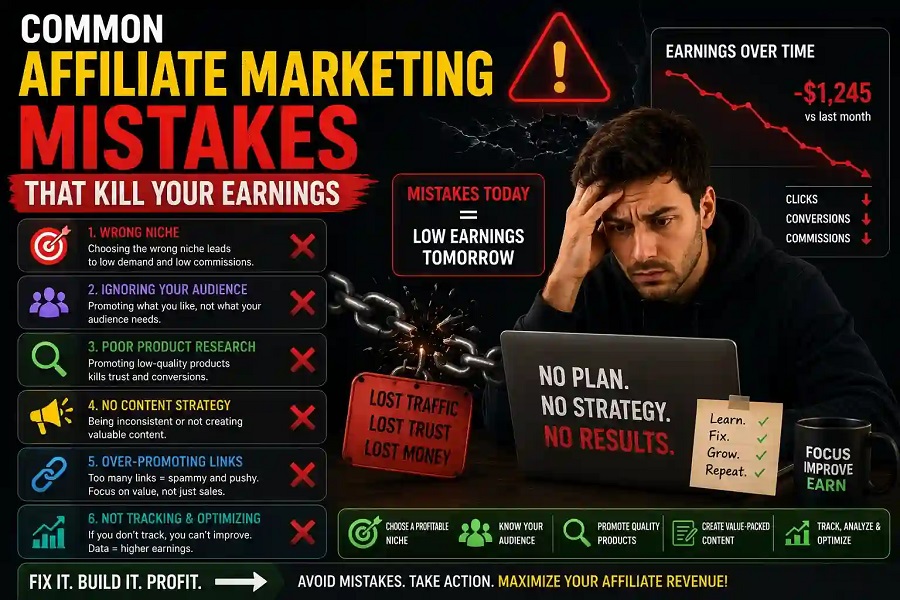
Most affiliate marketers don’t fail because they chose the wrong niche or joined the wrong program. They fail because of execution errors that silently drain commissions for months before the problem becomes obvious.
Some of these mistakes are structural — built into how the business was set up from the beginning. Others develop gradually as bad habits compound over time. All of them are fixable, but only once they’re identified clearly.
Strategic Mistakes That Prevent Affiliate Income From Starting
Before a single commission is earned, several foundational decisions determine whether an affiliate site has genuine income potential or simply creates the illusion of one.
- Targeting keywords without buyer intent — Publishing content that attracts curious readers rather than people actively evaluating purchases generates traffic that never converts. Informational queries build awareness; comparison and best-of queries capture buyers. Confusing the two wastes months of content effort on audiences that were never going to click affiliate links
- Joining too many programs across unrelated categories — Scattering affiliate relationships across dozens of unrelated products signals to audiences that no genuine expertise exists. Readers trust recommendations from publishers who demonstrate deep familiarity with a specific category — not those promoting everything simultaneously
- Selecting programs based on commission rate alone — A 40% commission on a product that nobody buys generates nothing. Program selection should be driven by product quality, merchant conversion rate, cookie duration, and alignment with what the audience actually needs
- Building on rented platforms exclusively — Affiliates who publish entirely on social media platforms, third-party marketplaces, or video channels without an owned website or email list have no stable foundation. Platform policy changes, algorithm shifts, or account suspensions can eliminate years of built traffic overnight
- Neglecting disclosure requirements — Failing to disclose affiliate relationships clearly violates regulatory requirements and erodes reader trust when discovered. Transparent disclosure, handled professionally, rarely reduces conversions and protects the business legally
- Entering oversaturated niches without differentiation — Attempting to compete in high-commission categories dominated by established publishers with superior domain authority, larger content libraries, and stronger backlink profiles — without a clear differentiating angle — produces rankings that never materialize
These decisions are made before content is written. Getting them wrong means that even excellent execution produces disappointing results.
Content and Conversion Mistakes That Suppress Commissions
Even affiliates with solid strategic foundations lose significant income through content and conversion errors that are invisible until specifically measured.
- Writing for search engines instead of buyers — Over-optimized content stuffed with keywords but lacking genuine product insight fails both search algorithms that prioritize helpfulness and readers who detect promotional writing immediately and distrust it
- Burying affiliate links too deep in content — Readers who find the recommendation helpful but can’t locate the link easily abandon the page without clicking. Contextual link placement near the point where buying intent peaks — typically after key benefits are explained — consistently outperforms links placed only at the end of long articles
- Using generic calls to action — “Click here” and “Buy now” tell readers nothing about what happens next or why it benefits them. Specific calls to action tied to outcomes — “Compare current pricing” or “See who this is best for” — increase click-through rates by communicating value rather than issuing commands
- Ignoring mobile experience — A significant portion of affiliate traffic arrives on mobile devices. Content that renders poorly on small screens, with links too closely spaced to tap accurately, loses conversions that desktop-optimized analytics don’t reveal
- Never updating old content — Affiliate content that references outdated pricing, discontinued products, or superseded information loses rankings gradually and converts poorly when the details no longer match what buyers find on the merchant site
- Measuring traffic instead of conversions — High page views feel like success but mean nothing if click-through rates on affiliate links are poor. Tracking earnings per click, conversion rate by content type, and revenue per thousand visitors reveals which content actually generates income versus which content simply generates visits
Relationship and Trust Mistakes That Cap Long-Term Growth
Affiliate income has a ceiling when it’s treated as a transaction business rather than a trust business. The publishers consistently earning the most from affiliate marketing have built something more durable than a collection of ranked pages — they’ve built audiences that return because previous recommendations proved genuinely valuable.
Recommending products that don’t deliver on their promises generates short-term commission and long-term audience erosion. A single dishonest review damages credibility that took months to build and is reflected in returning visitor rates, email unsubscribes, and negative comments that new visitors read before deciding whether to trust the site.
Never testing products personally — or at minimum researching them deeply through verified user experiences — means recommendations carry no genuine authority. Audiences sophisticated enough to convert at high rates are also sophisticated enough to recognize surface-level familiarity disguised as expertise.
Failing to build an email list means every affiliate recommendation reaches an audience once, through a single exposure. Email allows repeat recommendations to a warm audience that has already demonstrated interest — and warm audiences convert at multiples of cold search traffic regardless of offer quality.
Treating affiliate marketing as a set-and-forget business rather than an evolving relationship with an audience produces income that peaks early and declines as competitors publish fresher, deeper content and readers find more trustworthy sources.
The Mistakes Costing You the Most Are Probably Already Happening
The uncomfortable truth about affiliate marketing mistakes is that most of them are already occurring in active businesses — they’re just not visible in the data that affiliates typically monitor. Traffic looks stable. A few commissions arrive each month. Everything seems functional.
The signal that something is wrong is usually the gap between traffic volume and commission income — or between commission income and what similarly sized sites in the same niche generate. That gap is almost always explained by one or more of the mistakes above.
Audit the business honestly against this list. Identify the two or three mistakes having the greatest current impact. Fix those specifically before adding new content, new traffic channels, or new affiliate programs.
Fixing existing mistakes produces faster income improvement than adding new effort to a business with structural conversion problems still in place.
Frequently Asked Questions
Q: What is the single most damaging affiliate marketing mistake for long-term income?
Building without an email list. Social and search traffic is unpredictable and non-repeatable. An owned email audience provides a direct, stable channel for affiliate recommendations that compounds in value as it grows — independent of algorithm changes or platform decisions.
Q: How do I know if my affiliate content is targeting the right keywords?
Check whether the search queries driving traffic to your content include comparison, review, best, or versus language. These buyer-intent signals indicate visitors who are evaluating purchases. Purely informational traffic — how-to and what-is queries — rarely converts well for affiliate offers.
Q: Is it a mistake to promote affiliate products I haven’t personally used?
Not always — but it requires substantially deeper research through verified user experiences, detailed product documentation, and community feedback. Personal experience produces the most credible, specific, and trust-building content. Products recommended without either personal use or deep research produce thin content that audiences and algorithms both penalize.
Q: Why do some affiliate sites get lots of traffic but earn very little?
Usually because content targets informational rather than buyer-intent queries, affiliate links are poorly placed or missing from high-traffic pages, or the promoted products don’t match the audience’s actual purchase motivation. High traffic with low commissions is almost always a targeting and conversion problem, not a traffic problem.
Q: How often should affiliate content be updated to maintain performance?
High-traffic affiliate pages should be reviewed every three to six months and updated whenever pricing changes, new competing products emerge, or user experience observations become outdated. Annual comprehensive updates for evergreen content maintain rankings that gradual relevance decay would otherwise erode.