
Two paths dominate the dropshipping conversation — selling through Amazon’s marketplace or building an independent store on Shopify. Both work. Both have produced profitable businesses. And both carry risks that the other doesn’t.
The right choice depends entirely on what kind of business you’re trying to build — not on which platform sounds more impressive or generates more search results.
This comparison cuts through the surface-level differences and addresses what actually matters for dropshipping success in 2026.
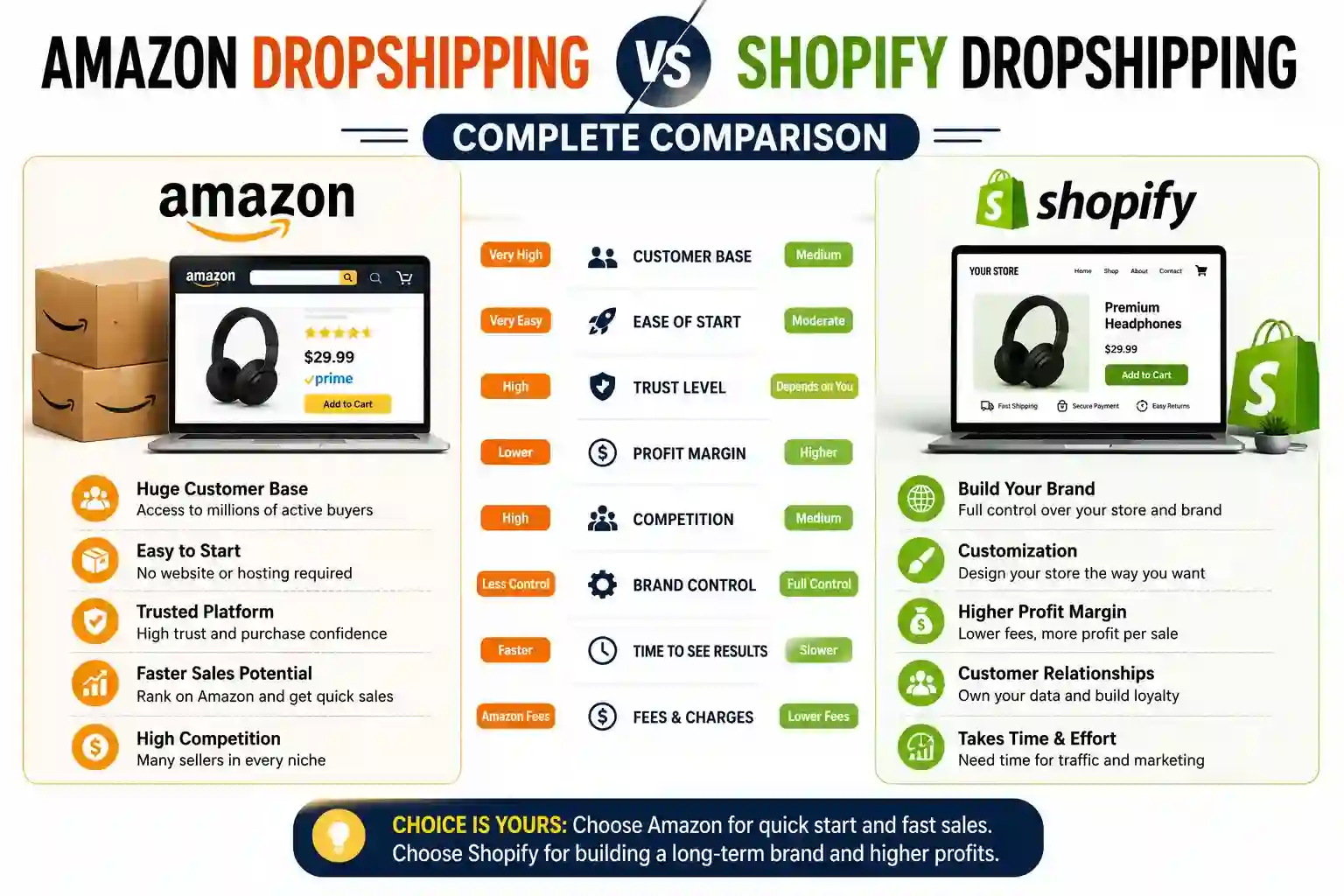
How Amazon Dropshipping Works and Where It Wins
Amazon dropshipping means listing products on Amazon’s marketplace that your supplier ships directly to customers. You never hold inventory. Amazon provides the storefront, the traffic, and the buyer trust — you provide the product listings and manage the supplier relationship.
The advantages of this model are significant for specific types of sellers:
- Built-in buyer traffic — Amazon attracts hundreds of millions of active buyers who arrive with purchase intent already established. New sellers access this audience immediately without building it from scratch through marketing spend or SEO effort
- Established trust infrastructure — Amazon’s brand credibility transfers to every seller on its platform. Buyers who hesitate to purchase from an unknown website checkout confidently on Amazon without second-guessing the transaction
- No store design or technical setup — Listing creation is straightforward. There’s no website to build, no theme to customize, and no payment gateway to configure. Time from decision to first listing is measured in hours
- Fulfillment expectations are set — Amazon’s standard delivery promises and return policies are already familiar to buyers. Sellers don’t need to establish or communicate these independently
- Low initial learning curve — Understanding product listing optimization and supplier coordination is simpler than managing a complete independent ecommerce operation with all its moving parts
- Mobile buyer access without optimization — Amazon’s app and mobile site handle mobile commerce natively. Sellers benefit from this without any mobile optimization effort on their part
The core limitation is that everything above comes at a cost — both financially and strategically. Amazon’s fees typically consume 15% or more of each sale before supplier cost, shipping, and any advertising spend. Margins that appear viable become thin or negative once all costs are calculated honestly.
How Shopify Dropshipping Works and Where It Wins
Shopify dropshipping means building your own branded online store where you control the customer relationship, the pricing, the design, and every aspect of the buyer experience. Traffic must be generated independently — through paid advertising, SEO, social media, or email marketing.
The structural advantages for long-term business building are substantial:
- Brand ownership — Every sale builds your brand’s recognition rather than Amazon’s. Repeat customers return to your store, not to a marketplace where competitors are listed beside your products
- Customer data ownership — Email addresses, purchase history, and customer behavior belong to you. This data drives retargeting, loyalty programs, and personalized marketing that Amazon sellers can never access
- Higher profit potential — Without marketplace fees consuming a fixed percentage of every transaction, Shopify stores operate at significantly healthier margins when traffic acquisition costs are managed effectively
- Pricing control without visible competition — Amazon product pages display competitor listings and price comparisons directly beneath your offer. On your Shopify store, your price is the only price the buyer sees during their decision
- No platform policy dependency — Amazon suspends seller accounts for policy violations — sometimes without clear explanation or easy appeal. Shopify store owners face no equivalent existential risk from a third-party marketplace decision
- Product and niche flexibility — Amazon restricts certain product categories, requires approval for others, and monitors listings aggressively for policy compliance. Shopify imposes far fewer limitations on what can be sold and how it’s presented
- Upsell and cross-sell capability — Post-purchase offers, bundle promotions, and checkout upsells on Shopify stores generate additional revenue per customer that Amazon’s checkout flow doesn’t permit sellers to implement
The limitation is equally clear — Shopify provides no organic traffic. Every visitor must be earned through marketing effort or paid acquisition, which requires skills and budget that Amazon sellers don’t need to develop immediately.
Side-by-Side Reality: Which Model Fits Your Situation
The theoretical advantages of each platform only matter if they match what you’re actually capable of executing right now.
Amazon dropshipping suits sellers who want to test product viability quickly without marketing investment, who are comfortable operating on thin margins in exchange for traffic access, and who accept the inherent vulnerability of building on someone else’s platform without owning the customer relationship.
Shopify dropshipping suits founders who are willing to invest time in learning traffic acquisition — whether through paid ads, content marketing, or email list building — who want to build a brand asset with long-term value, and who understand that the initial months require more effort in exchange for structural advantages that compound over time.
A common pattern among experienced dropshippers is starting on Amazon to validate product demand quickly, then building a Shopify store around winning products once margin and market viability are confirmed. This sequencing reduces the risk of investing in a full Shopify build for products that buyers don’t actually want at sufficient volume.
The danger is treating Amazon as a permanent business rather than a validation tool — and discovering after years of sales that you’ve built income on a foundation someone else controls entirely.
The Platform Is the Structure, Not the Strategy
Both Amazon and Shopify have produced dropshipping businesses that generate substantial income — and both have produced failed ventures from founders who chose the platform before understanding the business model.
What determines success isn’t which platform you use. It’s supplier reliability, product selection discipline, honest margin calculation, and consistent execution of whichever traffic and conversion strategy your platform requires.
Choose the platform that matches your current capabilities. Build the skills the platform demands. And evaluate whether the business you’re building belongs to you — or to the marketplace you’re renting space from.
Frequently Asked Questions
Q: Which platform has lower startup costs — Amazon or Shopify?
Amazon’s individual seller plan has no monthly fee but charges per-item selling fees plus referral fees on each sale. Shopify charges a fixed monthly subscription but lower per-transaction costs. For very low initial volume, Amazon costs less upfront. As volume grows, Shopify’s fixed cost structure typically becomes more economical.
Q: Can I run Amazon dropshipping and Shopify dropshipping simultaneously?
Yes — many experienced sellers do exactly this. Amazon serves as a traffic source and validation channel while the Shopify store builds brand equity and customer relationships. Managing both requires more operational capacity but diversifies income source risk effectively.
Q: Is Amazon dropshipping allowed under Amazon’s seller policies?
Amazon permits dropshipping under specific conditions — you must be the seller of record, your supplier cannot ship with their own branding, and you must handle all customer service. Violations of these specific requirements risk account suspension, so understanding the policy precisely before starting is essential.
Q: Which platform offers better long-term scalability for dropshipping?
Shopify offers superior long-term scalability because the business asset — brand, customer list, and store — is owned by the seller. Amazon-dependent businesses face margin compression as competition increases and carry permanent risk from platform policy changes that are outside the seller’s control.
Q: How long does it take to generate first sales on each platform?
Amazon sellers with well-optimized listings in demand categories can generate first sales within days of launching due to existing marketplace traffic. Shopify stores typically require two to eight weeks of marketing effort before consistent traffic and sales develop — longer if relying on SEO rather than paid advertising.